

KEY TAKEAWAYS
The discount rate has caught the investment story. The 10-year US Treasury yield reached its highest level since 2002.
China is repairing the pipe while opening the tap. More than 670 lenders closed last year as infrastructure policy turned expansionary.
Manila's weather shock is now a rates test. The BSP's policy rate stood at 4.75% before the warning.
Korea's pledge is becoming an asset map. Planned US energy investment now carries a reported $200bn headline.

The Asset Before the Funding
The market is still paying for announced capacity as though financing were a footnote. Reports indicate that global bond selling pushed the 10-year US Treasury yield to its highest level since 2002, just as Asia produced a new catalogue of power plants, data centres and infrastructure. The first-level reading is growth: more steel, more electricity, more productive assets. The second-level reading is The Hurdle, the same project now has to clear a higher discount rate before it improves any sovereign balance sheet. That is the marginal change the headline hides. Capital expenditure can raise potential output years from now while worsening external funding demand, contingent liabilities or curve steepness today. The asset is visible. The financing chain is not.

Where the Hurdle Meets the Pipe
A 10-year yield at a 2002 high changes the DSA through timing before it changes the growth forecast. The IMF's Asia outlook found that higher global term premia press regional yields through fiscal issuance, policy uncertainty and risk appetite. That chain reaches EM maturity walls through benchmark rates, hedging costs and the price of refinancing, even when current import cover is stable. A primary deficit funded at a higher marginal coupon compounds faster, while arrears or Paris Club relief address legacy claims rather than the cost of new capacity. Breakevens may describe inflation expectations. Curve steepness describes how expensive patience has become.
China's infrastructure impulse is colliding with a banking repair whose weakest links sit closest to local credit transmission. Reports indicate that more than 670 lenders closed last year as a new infrastructure push took shape. The latest IMF staff report states, “Financial stability risks remain elevated.” It identifies weaker profitability, less diversified funding and greater credit-quality concerns at mid-sized and smaller banks, alongside LGFV debt-servicing weakness. Relative to that baseline, closures may improve the system's architecture, but they do not prove that the remaining pipe can fund new projects without migrating risk elsewhere. The map anticipated fragility. This week's weather asks the same pipe to carry more water.
From Beijing's Branches to Manila's Fields
China's policy impulse does not yet reverse the Cautious demand call carried from The Unsettled Channel. The 670 closures strengthen the case that this is a credit-allocation question, not simply a stimulus-size question. Infrastructure becomes sovereign-credit support when viable projects generate cash flow, local liabilities stay visible and the bank-to-LGFV chain does not manufacture a future refinancing wall. Until that conversion is observable, the first-order boost and the second-order balance-sheet cost belong in the same frame. A larger tap can lift activity. A narrower pipe can still decide where the pressure breaks.
The Philippines turns a climate warning into a monetary sequencing problem with the policy rate at 4.75%. Reports indicate that a severe El Nino could damage agriculture and lift inflation. The latest IMF staff report advises accommodating a temporary inflation spike while containing expectations. The deviation is not that the Fund ignored climate risk. It is that the risk may arrive while the easing path is already in motion. Food imports can cushion supply, but they also move the shock toward the trade account and import cover. A temporary crop event becomes a credit issue only if it persists through inflation expectations, subsidies or external demand for food.
The Refinery the Court Stopped
Kenya's paused $16bn refinery is the frontier version of the week's capacity trap. Reports indicate that a court halted the Dangote project, which was intended to reduce East Africa's dependence on imported fuel. The legal pause matters before a bond reprices because it interrupts the proposed transmission from capital spending to lower import demand. It does not establish a fiscal loss or a sovereign liability, but it does delay the operating asset against which either benefit could be tested. The permit is now part of the funding model. A project can be strategic, financed and still not be financeable on schedule.
The 2002 Hurdle Meets Four Credits
The Standing Book reaches its 28-day review with the funding hurdle reinforced and the conversion test still open. The carried-forward front-end preference now meets a 10-year Treasury yield at its highest since 2002, evidence for continued timing caution rather than a performance claim. Korea's existing Constructive industrial view gains a reported $200bn US energy plan but still requires commercial cash flows. The Cautious Sub-Saharan China-demand view also persists because 670 bank closures and an infrastructure push do not yet establish broader commodity-import demand.
We Prefer the EM hard-currency front end over duration. This rolls forward the 4W stance in The Refinance Window: a 2002 high in the US 10-year raises refinancing sensitivity, while lower term premia and orderly EM duration would close the preference.
We are Cautious on China's bank-to-infrastructure transmission. The 670 lender closures reinforce, rather than settle, the weaker-bank question behind the existing China caution; broad credit without renewed LGFV or small-bank stress would change the 3M view.
We are Cautious on Philippines local rates. A 4.75% policy rate now faces an El Nino food shock; anchored expectations and no policy reversal would invalidate the 3M caution.
We remain Constructive on Korea's industrial transmission. The reported $200bn US energy plan extends the project pipeline discussed in The Refinance Window, but uncontracted revenues or policy-directed funding would reverse the 3M stance.
When Concrete Must Earn Its Coupon
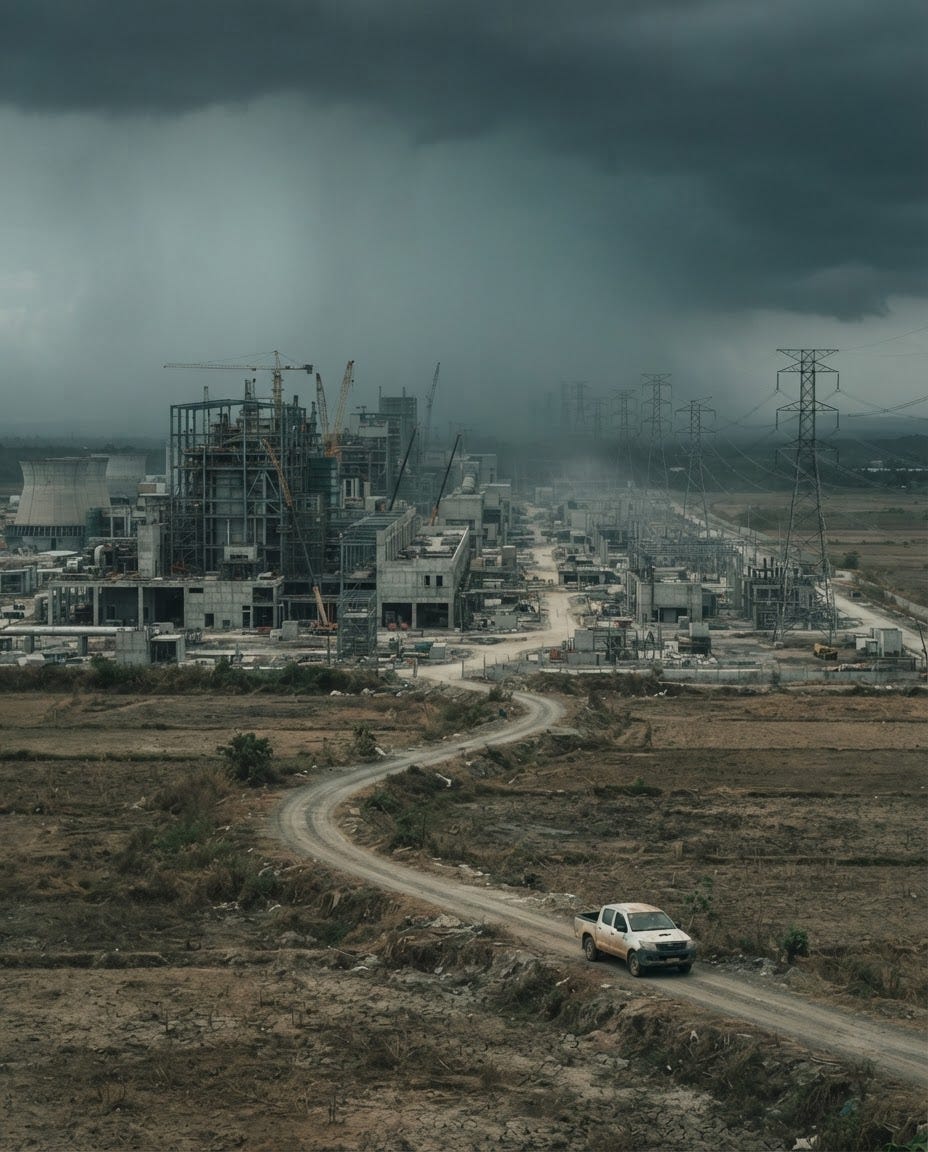
The next sovereign cycle will distinguish installed capacity from photographed capacity. A $200bn plan can deepen an industrial franchise. A $16bn refinery can lower an import bill. An infrastructure push can support demand. None escapes the 10-year discount rate, the local credit pipe or the permit that decides when cash flow begins. This desk is not arguing that investment is bad news. It is arguing that good development and good credit separate at the funding contract. That is The Capacity Toll. The asset must operate. The cash flow must travel. The coupon arrives regardless.
What Would Change Our Mind
The global hurdle retreats. A sustained reversal from the 2002 high in the US 10-year, led by lower term premia, would weaken the funding thesis.
Capacity converts into cash flow. Contracted revenues across the $200bn Korean plan and resumed legal progress on Kenya's $16bn refinery would strengthen the investment transmission.
The weather remains temporary. The next Philippines inflation release must show that food pressure is not broadening beyond the 4.75% policy setting.
Regards,
Sovereign Dispatcher