

KEY TAKEAWAYS
The IMF's Spring Meeting Is This Week's Most Underpriced Event. While the market focused on Trump floating US-Iran talks in Islamabad, Fund officials at their Spring Meetings warned that economic pain from the Iran war will hit poor countries hardest and some developing nations may require additional lending. This is not a forecast. It is a public admission that existing programme envelopes are undersized. Spreads have not moved.
Pakistan's Dual-Track Problem Is Accelerating. As we flagged in the April 12th Dispatch, the $3.5bn UAE repayment is a structural erosion of the IMF EFF's bilateral financing architecture. This week, Islamabad simultaneously becomes the venue for US-Iran diplomatic talks, elevating a mediator premium that the market is pricing as a credit positive. The geopolitical narrative and the fiscal arithmetic are now explicitly moving in opposite directions.
Turkey Faces a Two-Vector Baseline Collapse. The FT's question, "Will Turkey be forced to reverse rate cuts?" is not rhetorical. Energy-driven inflation and Erdogan's simultaneous political crackdown are degrading both the monetary and institutional pillars of the IMF's Turkey programme baseline, with the "Turkey is normalising" narrative losing structural support on two fronts at once.
Indonesia's Moscow Visit Is the Week's Canary. Prabowo's meeting with Putin, described by Nikkei as Indonesia being "pushed closer" to Russia by the Iran war, is not priced in Indonesian sovereign spreads. The IMF's Indonesia baseline assumed Western multilateral alignment. A sanctions-adjacency tail risk is opening in one of Asia's most important investment-grade credits.

Pricing the Diplomat, Not the Ledger
The market spent this week watching Islamabad. Trump floated US-Iran talks "within days," Pakistan confirmed its capital as the venue, China pressed Tehran to reopen the Hormuz Strait, and EM risk assets repriced the narrative of imminent diplomatic resolution with the familiar enthusiasm of a market that has learned to buy every ceasefire rumour since March. The behavioral logic is coherent on the surface: if Islamabad delivers a de-escalation framework, the energy shock that has been compressing import cover ratios across Asia and Africa begins to reverse. Spreads tighten, currencies stabilise, and the relief trade extends. The second-level question, the one the institutional bondholder must ask, is whether that surface logic still holds when you read the signal coming from the other Washington event no sell-side desk highlighted this week.
The IMF and World Bank Spring Meetings took place in Washington against the backdrop of the Iran conflict, and the Fund produced a statement that deserves far more attention than it received. Officials warned that economic pain from the Iran war will hit poor countries hardest and that "some developing countries may require additional lending." In the Fund's bureaucratic language, "may require additional lending" is not a hedge. It is a signal that the programme envelopes approved for frontier credits, the DSA frameworks, the primary balance targets, and the external financing assumptions, were calibrated to an energy price path that has not materialised. The IMF is, with characteristic institutional understatement, telling the market that its own maps are out of date. The market is watching Islamabad. The sovereign strategist is reading Washington.
The behavioral error this week is the conflation of diplomatic activity with credit improvement. A geopolitical negotiation hosted in Islamabad generates headlines. It does not generate hard currency. It does not rebuild Pakistan's bilateral creditor buffer. It does not restore the import cover ratios that Singapore's MAS tightened to protect this week when it explicitly cited the energy shock as the justification for its first monetary response since the conflict began. The gap between what the Islamabad narrative implies and what the Spring Meeting communique reveals is precisely the kind of disconnect that creates asymmetric positioning opportunities, when the market is looking in one direction and the structural evidence is pointing in another.

The Programme Envelope That No Longer Fits
The IMF Spring Meeting admission that frontier credits may require additional lending is best understood through the lens of what a programme envelope actually contains. A DSA-backed IMF programme is built on a set of assumptions: a primary balance target, an external financing quantum, an energy import cost path, and a set of bilateral creditor commitments that are treated as locked. The Iran war has violated at least three of these simultaneously for the most vulnerable programme countries. Energy import costs remain elevated well above the H2 2026 normalisation timeline that Fund staff embedded in 2025 programme reviews. The Singapore MAS action this week, the authority's first explicit monetary tightening in response to the energy shock, is the clearest market signal available that the H2 normalisation assumption is not on track. If MAS, the most credible monetary institution in Asia and the one operating in the region's most financially robust economy, is tightening because energy prices are still pushing up import costs, then the IMF's energy normalisation timeline for less creditworthy neighbours, Pakistan, Sri Lanka, the Philippines, is at minimum premature, and at maximum structurally wrong.
The Pakistan-specific dimension of the Spring Meeting signal deserves independent analysis, because the IMF's December 2025 EFF documentation created an explicit contractual commitment that this week's news has directly tested. The IMF's memorandum for Pakistan's Extended Fund Facility stated that "bilateral partners will also continue rolling over short-term claims, including loans, swaps and deposits, for the duration of the program." The Nikkei Asia report that Pakistan's $3.5bn UAE repayment "hints at cracks in ties" is not a geopolitical observation. It is a description of a bilateral partner demanding repayment rather than executing the rollover that the IMF programme's financing framework explicitly modelled. The SBP's NFA position, already thin relative to IMF programme benchmarks, loses a material support pillar with each billion that flows to Abu Dhabi rather than staying in Karachi. The programme's DSA was constructed around a fully-financed framework; one of the bilateral legs of that framework is now visibly wobbling.
The Bosphorus Reversal and the Jakarta Departure Gate
Turkey entered this week carrying the residual weight of the reserve sterilisation story we documented in the April 12th Dispatch, and the week added a second vector that the market has not yet absorbed. The FT asked explicitly whether Turkey would be forced to reverse its rate cuts, a question that goes to the structural core of the IMF's Turkey programme narrative. The CBRT's disinflation cycle was the centrepiece of the Fund's assessment that Turkey had turned a corner after the 2023 lira crisis. Rate cuts were premised on inflation declining sustainably toward the Fund's target path. The Iran war's energy shock has introduced an exogenous inflationary impulse that the rate-cutting cycle cannot easily absorb, and Erdogan's simultaneous political crackdown on rivals, described by analysts as among the worst in modern Turkish political history, is degrading the institutional credibility that IMF programmes require to function. The combination of a central bank under political pressure and an energy-driven inflation reversal is precisely the scenario that makes the IMF's Turkey baseline simultaneously optimistic on both its monetary and institutional assumptions.
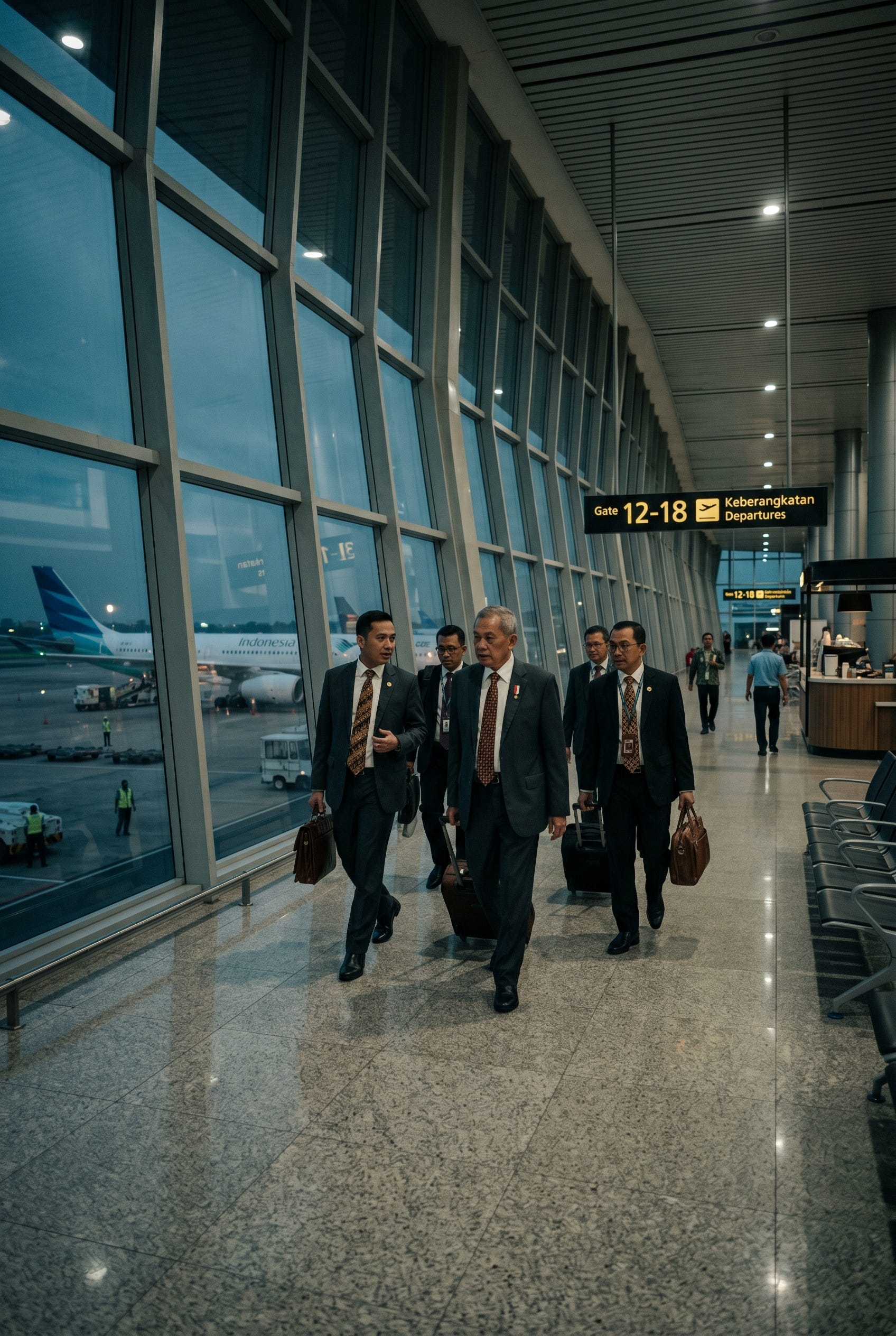
The canary this week sits in a different departure gate entirely. Nikkei Asia reported that Indonesia's President Prabowo met Vladimir Putin in Moscow, and that Indonesia was "pushed closer" to Russia by the dynamics of the US-Iran war, even as Prabowo's government drew domestic backlash for separately "entertaining a US airspace request." Indonesia is the world's fourth-largest country by population, the largest Muslim-majority sovereign, and one of Asia's most important investment-grade credits. The IMF's Indonesia Article IV assumed continued engagement with Western multilateral institutions and a stable external financing environment. Prabowo's in-person Moscow visit is not symbolic. Indonesia's simultaneous deflection of US military requests and cultivation of the Kremlin signals a deliberate positioning toward strategic non-alignment. For the sovereign bondholder, this introduces two tail risks that are entirely absent from current spread levels: access to Western bilateral lending, from the US, Japan's JBIC, and the European financing institutions, may be complicated if the alignment shift becomes structural; and if Indonesia's Russia engagement attracts secondary sanctions scrutiny from the US Treasury, its access to dollar-clearing channels becomes a tail risk in one of the region's deepest sovereign bond markets.
The Baseline Slippage Register
We are Cautious on Pakistan sovereign credit at current spread levels. The mediator premium from hosting US-Iran talks in Islamabad is real but ephemeral, measured in weeks not quarters. The bilateral creditor erosion documented by Nikkei is structural, measured in programme review cycles. The asymmetry favours patience over chasing the diplomatic narrative.
We are Cautious on Turkish local currency duration. The combination of a potential rate reversal driven by energy-driven inflation and the erosion of institutional credibility through political crackdowns creates a dual-exposure that the IMF's Turkey baseline did not model. As we noted in the April 12th Dispatch, Turkey's reserve position is weaker than headline gross figures suggest. Adding monetary policy uncertainty compounds the risk.
We Prefer Singapore dollar-linked instruments as a regional safe-haven expression within Asia. The MAS tightening confirms both the quality of Singapore's policy response and the persistence of the energy shock that weaker regional peers cannot credibly address.
We are Asymmetrically Cautious on Indonesian sovereign credit. Current spread levels do not price a Russia-alignment scenario or the associated sanctions-adjacency tail risk. The Moscow visit is the week's canary. The appropriate response is not immediate repositioning but an elevated vigilance threshold for confirmation signals over coming weeks.
We remain Cautious on the broader frontier developing-country basket. The IMF Spring Meeting admission that some sovereigns may require additional lending is a baseline revision that spread markets have not processed. When the Fund itself signals its programme envelopes are undersized, the asymmetric risk is on the wider side.
What the IMF Reveals When It Thinks No One Is Listening
The most dangerous inflection points in sovereign credit are not the dramatic moments. They are not the rating agency cuts, the missed coupon payments, or the emergency IMF press conferences with the finance minister standing behind a microphone at midnight. The dangerous moments are the institutional concessions made in conference room language, in communiques that generate no headlines, in footnotes to spring meeting statements where the Fund, with the most comprehensive sovereign balance sheet data available to any institution on earth, quietly signals that its own frameworks have been overtaken by events. The admission this week that some developing countries may require additional lending is precisely that kind of moment. It is the IMF's translation of a structural truth into bureaucratic language: the maps were drawn before the weather arrived, and the weather has been worse than the maps assumed. The market spent the week watching the diplomats in Islamabad. The institutional signal that will shape the next quarter's credit cycle was delivered in Washington, in language that rewarded patience over the narrative trade. Conviction is not built on what everyone is watching. It is built on what everyone is not.
Regards,
Sovereign Dispatcher