

KEY TAKEAWAYS
The Yen Fell to a 40-Year Low as Tokyo's Spending Overran Its Hike. The carry floor this desk called permanent two weeks ago is now a currency Japan may have to defend by intervention.
The IMF Moved Against the Hidden Leverage Buried in Frontier Debt. Its crackdown on Nigeria's total return swaps signals that reported debt understates the true obligations sitting off the balance sheet.
Indonesia Logged Its First Trade Deficit in Six Years. The current-account turn this desk flagged as building since The Tightening Gyre has arrived as hard data, not narrative.
Retail Euphoria and Sovereign Stress Are Running in the Same Week. A 3.6 billion dollar Chinese renewables IPO tripled on retail demand while the frontier's plumbing deteriorated beneath it.

The Market That Trades the Screen
The market spent the week reading three warnings as three green lights, and paid itself for the misreading. As this desk logged in The Sixty-Day Assumption and reaffirmed last week, the EMBI Global Diversified has held near the 229 basis points that marked the tightest levels of the year, on the belief that the quarter's structural risks had been filed and closed. Nothing this week disturbed that posture. The consensus read the yen's slide to a 40-year low as harmless stimulus, the BOJ's move to 1% as fully absorbed, and Asia's roaring primary market, a 3.6 billion dollar Chinese renewables listing that tripled on retail demand, as proof that risk appetite is healthy. Each read priced only what the screen displayed. A weakening currency is not stimulus once the authorities are guessing about intervention, an absorbed hike is not a settled one while the government floods the system with bonds, and a tripling IPO is a late-cycle tell, not an all-clear. The tape showed green. The plumbing beneath it did not.
The Gap the Curve Cannot Price
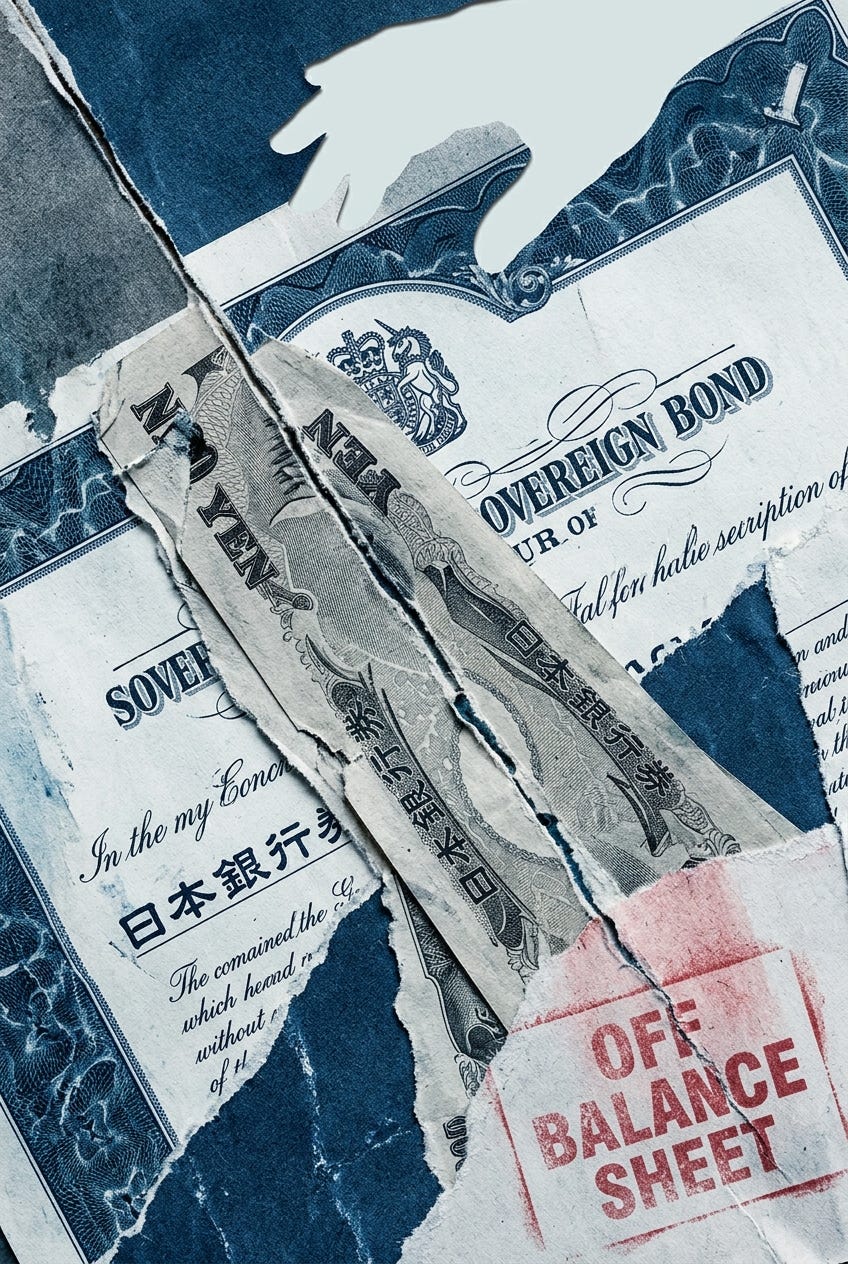
The decisive fact of the week was not the hike the market had filed, it was the currency that quietly broke a 40-year floor beneath it. The FT reported that Japan's fiscal expansion, tax cuts and new spending, is likely to push the yen down further unless the Bank of Japan tightens faster, and that the yen has hit a 40-year low against the dollar with the authorities keeping the market guessing on intervention. This is where the plumbing turns non-linear. The yen-carry funding leg that prices Pakistan, Egypt, and Ethiopian sovereign duration was repriced on the level of Japanese rates when the BOJ reached 1%. It is not priced for the discontinuity. If the Ministry of Finance intervenes, the yen snaps higher and the carry unwinds in a single session, a gap, not the gradual move the curve steepness implies. The IMF's Japan surveillance assumed normalization paired with fiscal consolidation, precisely so the currency would adjust smoothly. The delivered combination, a 1% rate against a record fiscal expansion, produced the opposite. Variance, not level, is the variable the spread declines to quote.
The same blindness governs the debt the ledger does not show, and this week the IMF moved to switch the lights on. The Fund opened a crackdown on opaque sovereign borrowing centered on Nigeria's use of total return swaps, the synthetic, off-balance-sheet leverage that lets a sovereign's true obligations sit outside its reported debt stock and outside the Debt Sustainability Analysis that bondholders trust. When those positions are forced into daylight, reported debt-to-GDP is revealed to understate the real maturity wall, and the swaps, which behave like short-term external debt under stress, can unwind and widen spreads on the underlying bonds regardless of fundamentals. Indonesia is the same lesson in a different account. The six-year-low trade surplus this desk flagged in The Tightening Gyre has flipped to an outright deficit, the first in six years, the current-account turn arriving as a printed number rather than a forecast. A concealed maturity wall, a concealed deficit, an intervention that has not fired. Import cover compresses while the primary balance widens. The Article IV map assumed each of these was visible. None of them was.
From Tokyo's Tremor to Lagos and Jakarta
For the bondholder funding a position in Islamabad or Cairo, the yen's 40-year low is not a distant Tokyo story, it is the price of his own leverage shifting under him. The frontier's dollar-scarce sovereigns, Pakistan, Egypt, Ethiopia, refinance against a yen-carry leg that has just become a jump risk rather than a trend. As long as the yen drifts, the funding cost drifts with it and the spread can pretend nothing has changed. The moment the Ministry of Finance defends the currency, the carry unwinds in a gap and the marginal buyer of frontier duration disappears in the same session. This is the Proxy this desk has tracked all quarter, now running in reverse: not a frontier borrowing a foreign catalyst, but a frontier borrowing a foreign currency's stability, and that stability is a 40-year low away from breaking. The bondholder is long a calm he does not control.
Beneath the funding shock, the frontier is sorting itself into those whose risk is hidden and those whose catalysts are visible. Nigeria and Indonesia now sit on the hidden side: Lagos with off-ledger swaps the IMF is dragging into the open, Jakarta with a current-account turn its surplus concealed until the number flipped, both compounded by a foreign-investor confidence shock as a Jakarta court sentenced the former Gojek chief to 10 years in a case the Street is watching. Against them stands India, the one credit manufacturing catalysts in plain sight: two listings set to raise a combined 7 billion dollars, Amazon now the largest foreign investor in its AI sector, and a first defense codevelopment pact with Japan alongside Tokyo trade insurance for Reliance's solar and battery build. The FT caught the reflex running the other way in Tokyo, where foreign investors fear Japan is "backsliding on reform," the pendulum "swinging back towards economic nationalism." India is the inverse of that sentence. The tide is the same global liquidity; the hulls are not.
The Valve Delhi Controls in Kathmandu
The signal the wires will miss sits in a crate of Nepali tea held at the Indian border. Nikkei reported a brewing crisis for Nepali tea exporters as India tightens quality checks, a regulatory barrier rather than a tariff, and the distinction is the danger. Nepal is a small, landlocked frontier whose external accounts lean on remittances and a handful of hard-currency exports, and India is simultaneously its dominant market, its transit route to the sea, and the corridor for the remittances that stock its reserves. A quality check is a valve, and Delhi holds it. Choke one of Kathmandu's few export earners and the compression feeds straight through to the foreign-exchange receipts that service external debt and hold import cover. It is the same Delhi that expelled thousands of migrants into Bangladesh in the dead of night this week. The lesson for the frontier bondholder is that South Asia's small sovereigns are increasingly price-takers on India's administrative decisions, an idiosyncratic risk the generic spread does not decompose until the reserves are already thinner.

Positioning for the Jump, Not the Drift
We are Cautious on Indonesia across the capital structure. This is consistent with the Cautious stance this desk has held since The Tightening Gyre, now hardened from narrative into hard data by the first trade deficit in six years. A restored surplus and an MSCI review settled without delistings would flip it; a deficit widening into the classification decision would not.
We are Cautious on Nigeria hard-currency debt, a new position. The IMF's move against total return swaps is constructive for long-run transparency and a repricing risk in the near term, because forcing hidden leverage into the open surfaces the true obligation before it cleans it up. A disclosure that lands without upward debt revisions or forced unwinds would ease us; a revised debt stock would not.
We are Constructive, selectively, on India. Consistent with last week, and the scheduled catalysts have multiplied: a 7 billion dollar listing pipeline, Amazon's AI commitment, and the Japan defense and Reliance deals, set against a single weather variable. A normal monsoon validates the rupee defense; a failed one turns food inflation into a rate-hold dilemma.
We see Asymmetry in Pakistan, binary on the US-Iran track. Consistent with The Fiscal Counterweight, and this week the parties were not even in the same room in Doha, tilting the near odds toward stall. A signed settlement with attached support is a one-off inflow the spread underweights; a stall leaves the maturity wall untouched.
The Arithmetic of the Unseen
Every risk on the screen this week read as benign, and that is precisely why the screen was the wrong place to look. The market is a machine for pricing what it can see, and it saw a manageable hike, a stimulative currency, and an IPO tripling in a session, and it called the sum of them safety. But the risks that move frontier credit are rarely the ones carrying a live quote. They are the intervention that has not fired, the swap that sits off the balance sheet, the deficit the surplus hid until the month it flipped. Two weeks ago this desk called the carry floor permanent, and the word has aged as badly as the vocabulary of permanence always does, with the yen at a 40-year low as the market's rebuttal, delivered in a currency rather than a headline. The lesson is not that the visible risks are wrong. It is that the visible risks are priced, and priced risk is the cheap kind. Watch the ledger no one is reading. Price the jump, not the drift. The number that costs you is the one that was never on the screen.
What Would Change Our Mind
A decisive Ministry of Finance yen intervention or a faster BOJ hiking path that stabilizes the currency and takes the gap risk out of the frontier's funding leg.
A signed US-Iran settlement carrying real balance-of-payments support for Pakistan, or an orderly IMF-led disclosure of frontier swap positions that arrives without forced unwinds.
Japan's June core CPI and the next Indonesian monthly trade balance, both printing in the second half of July, alongside any confirmed MOF intervention.
Regards,
Sovereign Dispatcher