


KEY TAKEAWAYS
Jakarta Named a Sole Successor, and the Rupiah Still Gave the Move Back. Gramercy's August 15 weekly notes the rupiah strengthened, then reversed mid-week, after Damayanti's nomination as Bank Indonesia's only Governor candidate.
Merrill's Own Defense Note Put Nigeria on Its List of Strike Sites. The August 17 Capital Market Outlook counts 620-plus U.S. military strikes since January, naming Somalia, Nigeria and Venezuela among the theatres.
Tehran Hardened Its Posture the Same Week Both Sides Extended a Truce. Gramercy reports Iran's new security chief has shifted to an "offensive doctrine" even as the 60 day ceasefire was extended past expiry.
India's Inflation Sat Mid-Band While Its Equity Tape Slipped. July CPI rose to 4.45%, comfortably inside the RBI's 2 to 6% target, even as MSCI India fell 0.50% on the week.

The Street Called the Nomination the Fix
The weight of sell-side capital this week read Jakarta's central bank succession as a problem solved rather than a problem opened. Gramercy's August 15 EM Weekly frames President Prabowo's nomination of Destry Damayanti, acting Governor since Perry Warjiyo's July 27 resignation, as the sole candidate to lead Bank Indonesia, judging that the move reduces the immediate risk of greater monetary policy politicization and provides markets a credible technocratic counterpart. The same note welcomes Prabowo's Friday budget address, a 2027 fiscal deficit target of 2.4% of GDP, as a step that should ease near-term credit concerns. Merrill Lynch's August 17 Capital Market Outlook keeps its broader emerging market book at overweight inside a Macro Strategy section calling the risk asset outlook constructive, citing a soft July payrolls print, down 23,000 jobs, as grounds for lower September hike odds. A credible technocrat nominated and a Fed boxed toward patience is, on the Street's read, coherence rather than risk.
The Fund's Bar Sits Higher Than a Nomination
A nomination is an input, not a delivered policy, and the IMF's own resilience framework has never scored the difference generously. The Fund's October 2025 World Economic Outlook, cited by this desk since The Crossed Threshold, conditions emerging market resilience on disciplined domestic policy actually executed and on contained developed market rate volatility, not on the naming of a credible face to execute it later. Parliament, which returned from recess on August 14, has not yet confirmed Damayanti, and Gramercy's own note concedes that policy and governance uncertainty remains a source of volatility in the same paragraph that calls the nomination stabilising. The distinction matters because the desk's Indonesia invalidation, set out first in The Return Address and rolled forward through The Seven-Day Regime, requires a permanent governor confirmed alongside an implemented commodities reform, not a floated one. Neither condition clears this week.
Merrill's own quote is the tell for the wider book, not just Indonesia. "The risk asset outlook remains constructive," the August 17 letter states, in a publication that separately documents the U.S. has expended roughly two thirds of its Patriot interceptor stock, down to as few as 759, and lost more than a third of its THAAD inventory since the ceasefire with Iran. A constructive risk view and a depleted air defence posture sitting eight months into an unresolved Hormuz standoff are not contradictions the IMF framework requires this desk to reconcile for the bank, only to notice that the bank has not reconciled them itself.
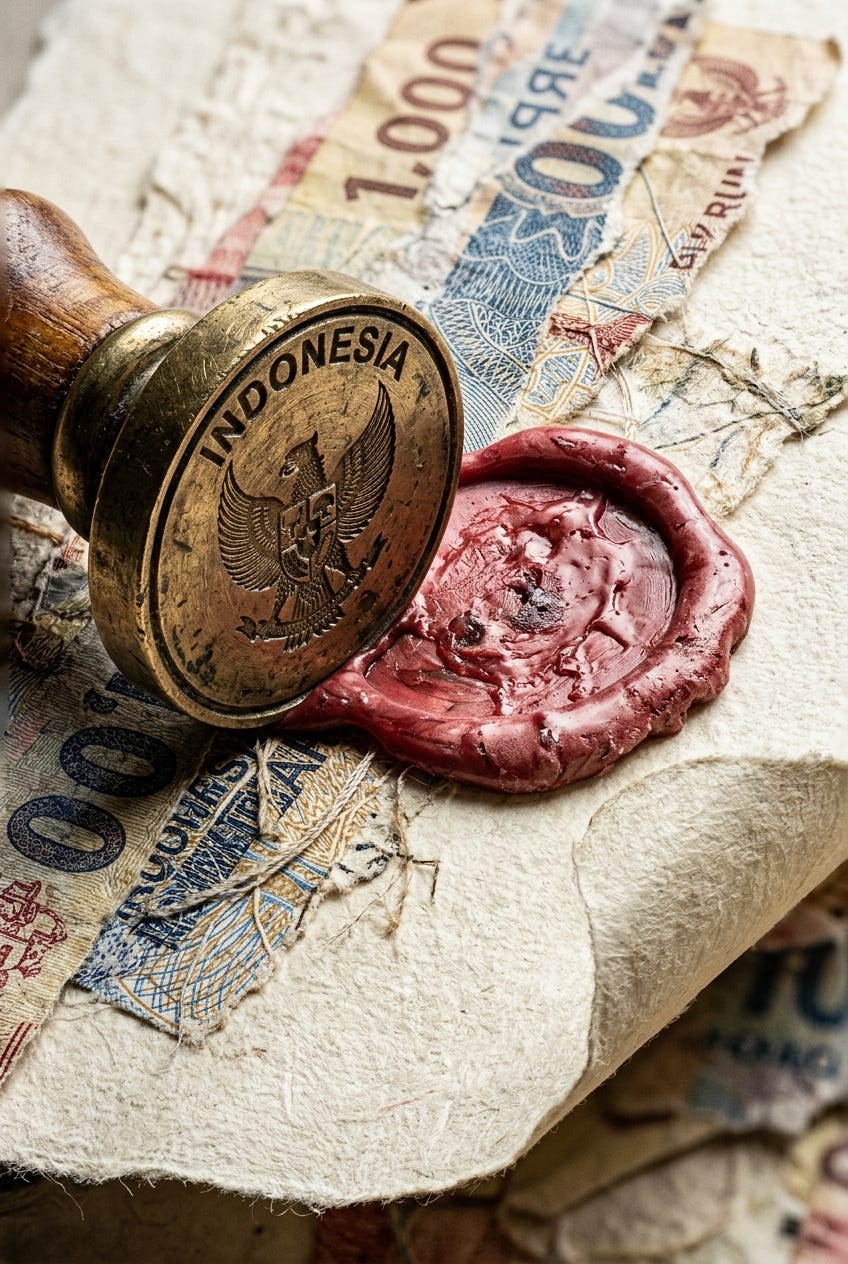
The Currency That Didn't Wait for Confirmation
Jakarta's local bonds and its currency told two different stories in the same week, and the tape chose the more skeptical one first. Asian local debt was the region's best-performing hard currency and local sovereign cohort in Gramercy's August 15 data, led by Indonesia's 0.77% local bond rally, price up 0.51%, even as the rupiah gave back its post-nomination strength mid-week. A bond rally without a currency to match it is a bet on the mechanics of a nomination working out, not evidence it already has. The split is the frontier's version of the Half-Life this desk named in The Seven-Day Regime, an announcement re-priced favourably in one instrument before the market that trades the country's actual solvency, the currency, confirmed the read.
The same skepticism is visible in how the tape is pricing the Hormuz standoff, not just Jakarta. Gramercy's August 15 note confirms Iran's talks with Washington remain deadlocked and its new Security Chief has moved the country to an "offensive doctrine," even as both sides agreed to extend the 60 day ceasefire past its August 17 expiry, a truce extended without a resolution beneath it. Brent held in the mid to high $80s, GS Asset Management's August 14 Market Monitor puts WTI at $82.40 and Brent at $88.52, keeping a geopolitical premium in the price importers still pay and exporters still collect. Net importer credits across this desk's Asia coverage benefit from that premium fading, but a truce extension is not a resolution, and the front end of the curve keeps pricing the difference better than duration does.
The Line Merrill Buried in Its Own Defense Note
Inside Merrill's August 17 Capital Market Outlook, a section titled Sounding the Arsenal Alarm documents more than 620 U.S. military strikes authorised since the administration returned to office, and cites operations extending beyond the Middle East into Africa and the Western Hemisphere, naming Somalia, Nigeria and Venezuela among the theatres. The same letter's Macro Strategy section keeps a constructive risk asset stance and never connects the two, but the plumbing runs directly through this desk's book. Nigeria's Constructive call rests on refining capacity and a current account trajectory the Fund has modelled out to 24 months, a thesis about industrial execution, not about the sovereign's exposure to being a named theatre in someone else's rearmament cycle. A single line in a defence strategist's section, not the bank's EM desk, is the first written acknowledgement this desk has seen naming Nigeria inside that list, and it is a data point the Nigeria thesis now has to carry, not one it has yet been tested against.

Holding the Line Before Jakarta Votes
We are Cautious on Indonesian hard currency debt, rolled forward and reconciled, not upgraded. Damayanti's nomination is genuine progress toward the confirmation half of this desk's two-part invalidation trigger, but Parliament has not voted, and the commodities reform half remains unaddressed since being withdrawn in The Seven-Day Regime. Both conditions, not one, are required to flip the read.
We are Cautious on Indonesian hard currency debt, only the confirmation half of the trigger having moved this week.
We are Asymmetry on Pakistan external sovereign debt, consistent with The Seven-Day Regime. Cash disbursement on the $10bn facility, reconciled cleanly against the EFF's existing assurances, resolves this favourably; a further characterisation of the Kashmir unrest as destabilising resolves it the other way.
We are Constructive on the Indian rupee and external accounts, rolled forward from The Return Address. July CPI at 4.45% sitting comfortably inside the RBI's band this week is supportive, not sufficient on its own to close the position.
We are Constructive on India sovereign and equity, strategic leg, rolled forward. MSCI India's 0.50% weekly decline is noise against the invalidation trigger, a concession that stalls the industrial policy programme, which nothing this week supplied.
We are Cautious on Sub-Saharan African commodity exporters, rolled forward unchanged, the China demand floor thesis still untested this week.
We are Constructive on Nigerian refining capacity and the current account, rolled forward, now carrying Merrill's Arsenal Alarm citation as a monitored input rather than an invalidation. A confirmed strike touching export or refining infrastructure would move this the other way.
We Prefer the front end of the EM hard-currency curve over duration, consistent with The Seven-Day Regime. A record-weak 30-year Treasury auction, per Gramercy's August 15 note, cleared at its highest yield since 2001 the same week September hike odds fell below 30%, confirming the front end still compensates for supply risk duration does not.
What a Nomination Cannot Settle
A nomination announces an intention, and a confirmation vote is the only instrument that turns intention into policy, and this week's frontier tape was a lesson in the space between the two. Jakarta named the one candidate everyone expected and the currency still could not hold its own rally. Merrill kept its risk asset view constructive in the same letter that counted its own country's depleted interceptor stock and named Nigeria on a list its EM desk never read. Iran hardened its language the same week both sides extended a truce neither has resolved. None of it required this desk to change a single position. It required this desk to keep pricing the gap between what was announced and what was actually delivered. A candidate is not a confirmation. A truce is not a resolution. The tape already knows the difference.
What Would Change Our Mind
A September Fed hike back above 50% probability. That would reprice the front-end preference this desk has held since The Seven-Day Regime and remove the supply-driven cushion Gramercy's August 15 note still assigns the belly of the curve.
A confirmed strike or interdiction event inside Nigeria. A named operation touching export or refining infrastructure, not just a defence strategist's country list, would move the Nigeria thesis from monitored input to invalidation.
Indonesia's parliamentary vote on Damayanti's confirmation, expected after Parliament's return on August 14, the first half of this desk's two-part invalidation trigger.
Regards,
Sovereign Dispatcher