

KEY TAKEAWAYS
The War Taxes the Frontier Through Reserves, Not the Coupon. India's foreign exchange reserves have fallen $54bn since the Iran war began, a settled drawdown the spread has yet to price.
Even the Gulf Is Routing Around Hormuz. Dubai is building capacity on the UAE's east coast to bypass the strait, conceding that the chokepoint premium is durable rather than a passing spike.
The IMF Pre-Flagged This Exact Oil-Importer Risk in October. Its Middle East outlook warned a renewed Iran escalation would challenge importers reliant on foreign fuel, the baseline the war has now triggered.
China Removes the Offset as Q2 Growth Undershoots Its Target. Beijing's second-quarter GDP fell below its own annual range, keeping the demand floor low beneath every African commodity exporter.

The Comfort of the Crude Tape
The market spent the week trading the war the only way it knows how, through the crude tape, and mistook a familiar reflex for a considered position. The US struck Iran after two American troops were killed in Jordan, the FT described a battle for control of the Strait of Hormuz with Tehran launching attacks on Gulf states, and the screen did what it always does with a supply shock. Oil rose, stocks and bonds fell, and the crowd moved into risk-off. The reflex is to price a contained conflict and a temporary spike, and to treat the frontier as high-beta risk that sells off with everything and recovers with everything. That is first-level thinking, and it reads the war as an oil-price event to be traded rather than a balance-of-payments event to be underwritten sovereign by sovereign. The second-level reading begins with a number the oil tape is not showing. India's foreign exchange reserves have already surrendered $54bn since the war began. The tape is loud. The ledger is quiet.
Where the Toll Is Paid
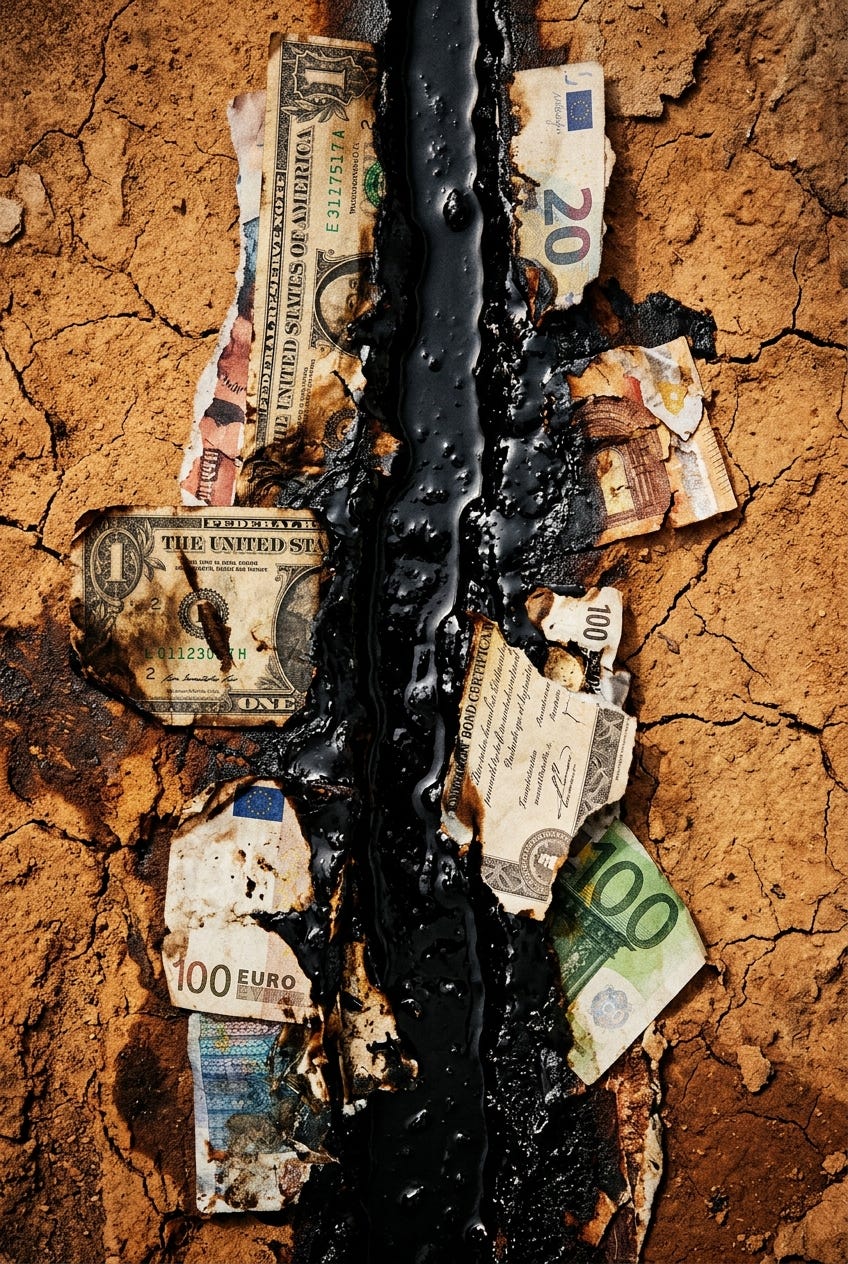
Price the war through import cover, the metric the IMF watches most closely for a frontier importer, and the transmission stops looking like a spike and starts looking like a toll. Import cover is simply the number of months of imports a country's reserves can finance, and a chokepoint war compresses it from both ends at once, because the energy bill rises as oil climbs while the reserves that pay for it drain as capital flees. India is the live demonstration, $54bn of reserves gone since the war began and a central bank reduced to courting diaspora deposits to defend the rupee. This is not a mark-to-market wobble in a spread, it is a drawdown on the asset side of the sovereign ledger, the side the screen is slow to quote. A chokepoint does not merely raise the price of what passes through it. It levies a toll on every importer downstream, and the toll is collected in reserves and import cover, not in the headline crude print.
The Fund itself pre-wrote this, which is what makes the market's surprise so telling. Its October Regional Economic Outlook for the Middle East and Central Asia warned that a renewed Iran escalation "could pose challenges for oil-importers, particularly those with... heavy reliance on imported fuel," precisely the sovereigns now paying the toll. This lands, moreover, on top of a funding-side withdrawal that has not gone away. As this desk tracked in The Homeward Tide, Japanese capital is being drawn home as JGB yields hold a 30-year high and Tokyo calls its pension savings back, lifting the yen-carry funding floor beneath Pakistani, Egyptian, and Ethiopian duration. So the frontier importer now faces a squeeze from both ends of the balance of payments in the same fortnight, a costlier energy bill and a shrinking reserve buffer on the import side, and a dearer, scarcer funding pool on the financing side. The maturity walls do not pause for either. Two withdrawals, one arithmetic.
The Bondholder Downstream of the Strait
Follow the toll downstream and it lands first on Pakistan, the credit this desk has tracked as The Proxy, and this week both legs of that trade moved against it. Pakistani sovereign duration prices off the yen-carry funding floor that reached a 30-year high as Tokyo turned homeward, and no signed balance-of-payments package has arrived to offset it. Now the import side turns too. A hot war over Hormuz, through which Pakistan's oil must transit, raises the energy bill for a chronic importer with thin reserves and a live maturity wall, the exact combination the Fund's programme assumes is financeable. And the domestic offset meant to help is cracking at the source, with a China-backed copper mine threatening to shut over worsening Balochistan security, removing a future hard-currency earner from the debt-sustainability math. The binary is unchanged in shape. A signed, cash-attached settlement is still a genuine one-off inflow the spread underweights. A stall now simply costs more than it did a month ago.
One layer up sits India, where the same toll produces a split rather than a single verdict, and the reconciliation matters more than the headline. Last week the desk stayed Constructive on India with the monsoon named as the one binding risk, and the war has moved that constraint. The binding risk is no longer the weather but the external account, and the $54bn reserve loss with foreign investors fleeing at the fastest pace on record is a real capital-account strain the earlier call did not carry. Yet the structural story that earned the Constructive stance is intact and arguably sharper, because the UK-India trade deal went live this week, European trade deals are reviving textile exporters, and India Inc is buying abroad rather than retreating while Modi tours to lock in uranium and critical minerals. So the desk splits the credit. The strategic and equity leg stays Constructive. The rupee and the reserves turn Cautious. Diversification is not immunity from a chokepoint.
The Creditor Port Moresby Chose
The signal the wires will file as diplomacy sits in the South Pacific, where Papua New Guinea said it will shut Taiwan's office and won China's praise while Washington declared itself deeply concerned. The mainstream reads one more micro-state switching sides in the recognition contest and moves on. The sovereign-credit read is sharper and sits on the financing side of the ledger. Papua New Guinea is a resource-backed frontier borrower whose LNG and mining projects run on Western and multilateral capital, project-finance insurance, and the goodwill of the institutions that underwrite its fiscal gaps, and a visible tilt toward Beijing reprices the political-risk premium on exactly those flows. The mechanism to watch is the creditor bloc the closure announces, because a sovereign choosing its funder ahead of need is the cleanest early instance of the realignment the great-power resource contest is forcing, in a week the FT put the cost of cutting the West's reliance on China at $23tn. The office is the headline. The funder is the signal.

The Names That Pay the Toll
We stay Constructive on India's strategic and equity story, rolling the standing stance forward rather than restating it as new. The UK-India trade deal is now live and India Inc keeps buying abroad, confidence signals a draining capital account does not produce. A prolonged Hormuz war that overwhelms the diversification story would force a rethink; a ceasefire validates it outright.
We turn Cautious on the Indian rupee and the external accounts, a deliberate change from a fortnight ago when the monsoon was the only flagged risk. A $54bn reserve loss defended partly by diaspora deposits is an expensive, defensive funding source, and record foreign outflows into a war are a real strain. A reopened strait and stabilising reserves would flip it back.
We hold Asymmetry on Pakistan external debt, consistent with The Proxy but carrying a deeper downside than a month ago. The funding floor sits at a 30-year high, the energy bill is rising, and the Balochistan mine has removed a resource offset, all while the signature Islamabad needs stays absent. A signed, cash-attached package resolves it favourably; a stall now costs more.
We are Cautious on the frontier oil-importer tier, Egypt the sharpest case, a new framing built on import cover rather than the crude price. Egypt runs on imported oil and LNG against a thin reserve buffer and a programme that assumes Gulf support, in the same week the Gulf itself came under attack and began rerouting its own trade around Hormuz. A durable reopening of the strait rebuilds the buffer; a prolonged contest drains it.
We remain Cautious on the Sub-Saharan commodity exporters through the China floor, consistent with last week and reinforced this week. China's second-quarter GDP printed below its own target range with only a high-tech stimulus debated, keeping the import-demand floor low beneath Angola, Zambia, and Nigeria. A big-bang consumption stimulus flips the read; continued deceleration keeps it drifting down.
The Invoice Arrives First
A toll is collected whether or not the payer is watching the gate. That is the week in one line. The screen spent it trading the crude tape, pricing a contained war and a temporary spike, while the actual damage was booked somewhere the screen does not look, on the asset side of the sovereign ledger. India has already surrendered $54bn in reserves, the Gulf is spending capital to route around a strait it can no longer trust, and the Fund's own October outlook named the oil-importer as the casualty months before the first missile. None of it arrived with a widening spread, so the market has filed none of it. That is the lesson the cycle keeps teaching at the moment the consensus most wants to look away. Funding and reserves leave before price does. The invoice is written in months of import cover, not basis points. The spread quotes the war as a headline. The reserves have already paid the toll. Read the ledger, not the tape.
What Would Change Our Mind
A durable reopening of Hormuz. A verified ceasefire that reopens the strait and pulls oil back toward its pre-war level would relieve the import-cover toll across the frontier's oil importers and reopen the beta case this desk is declining.
A signed, cash-attached package for Pakistan or Egypt. Concrete Gulf or multilateral support wired rather than promised would prove the bilateral backstop still functions despite the Gulf itself being under attack.
India's next weekly reserve print. The RBI's Friday reserve data showing the $54bn drawdown arrested, or extended, is the single datum that most directly tests this week's thesis.
Regards,
Sovereign Dispatcher