


KEY TAKEAWAYS
Islamabad Is Trading Away the One Creditor That Waits. Pakistan's finance minister outlined a return to capital markets borrowing to cut bilateral dependence, against Fund-projected import cover that reaches only 2.7 months.
The Yen Risk Stopped Being a Currency Problem. Japan logged a third consecutive monthly trade deficit in July, turning the carry unwind from an intervention question into a policy path.
India Handed This Desk Two Adverse Prints in One Week. Reliance on Russian crude hit an all-time high while the largest private bank lost its chief executive months after its chair departed.
Seoul Is Tightening From Strength, Not From Defense. The Bank of Korea took rates to 3% on AI-driven demand, the only non-defensive configuration in this week's file.

Twelve Months of Not Being Crushed
The market spent this week grading emerging market credit on a curve, and passed it for not having failed. The FT's Lex column set the tone, asking why 5% Treasuries are not crushing emerging markets and concluding that owning the asset class "has not been so terrible in the past year". That is the consensus into this weekend, that the rate shock arrived, the asset class absorbed it, and the funding stress this desk has tracked since The Return Address can now be filed as a scare rather than a regime. Survival is being read as strength. They are not the same thing, and the gap between them is the whole question. A sovereign that did not default under 5% Treasuries has told you what it could withstand. It has told you nothing about what it now owes, or to whom. The price action implies a best case in which the creditor stack behind every frontier balance sheet sat still while the rates cycle passed overhead. In the most closely watched credit on this desk's book, it did not.

The Creditor You Cannot Reschedule
The decisive event of the week was not a price, it was a proposed change to who Pakistan owes. The FT reports Islamabad's finance minister outlining a planned return to capital markets borrowing, explicitly framed as cutting dependence on bilateral debt and seeking US funding in place of it. The wires filed this as diversification. Set it against the anchor this desk has cited since The Return Address, the December 2025 EFF review, which calls the programme fully financed for twelve months through a combination of IMF, bilateral and multilateral commitments, with months of import cover projected to rise only from 1.6 to 2.7 across the programme horizon. The load-bearing word in that sentence is bilateral. The Fund's financing assurances framework treats committed bilateral support as a materially different category from prospective market access, which is why programmes are built on the former and not the latter.
Bilateral debt is patient debt, and patience is the asset Islamabad is proposing to surrender. A bilateral creditor lends for reasons other than the coupon, which is why it rolls, reprofiles, and sits down at a Paris Club table when the arithmetic tightens. A bondholder does none of these things. Swapping one for the other lowers a concentration statistic and raises the actual refinancing risk, because it converts a soft constraint into a hard maturity wall that no DSA can negotiate with. This desk names the mechanism the Patience Premium, the yield a sovereign implicitly earns by owing money to creditors with motives beyond repayment, and the premium it forfeits the moment it trades them for priced ones. For a sovereign whose import cover tops out under three months, that optionality is the most valuable line on the liability side. Nikkei's separate report that a China-built data centre has stirred a domestic debate over Pakistan's digital sovereignty suggests the relationship is being renegotiated on more than one front at once.
Tokyo's Deficit and Delhi's Barrel
The funding leg beneath frontier duration changed mechanism this week, and the direction of travel is worse for being slower. The FT's Monetary Policy Radar team reads the Bank of Japan's August forecast as yen weakness and rising inflation pushing the bank toward earlier tightening, while Nikkei reports Ueda will skip Jackson Hole in favour of board member Tamura and deputy governor Himino drove home inflation risks without hinting at a hike. Underneath the communication sits a third consecutive monthly trade deficit in July, which means the current account is no longer supporting the currency and the argument that yen weakness self-corrects without policy has quietly expired. Since The Seven-Day Regime this desk has argued the risk was an intervention that fades. That was an FX risk. A carry trade does not unwind because a central bank hikes once, it unwinds when the market concludes the hiking path is real, and this is the kind of week in which that conclusion forms.
Delhi supplied the week's second lesson, and it went against a position this desk holds. The FT reports India's reliance on Russian oil at an all-time high, with Middle East conflict exposing New Delhi's energy security vulnerabilities, in the same week China warned it would take all necessary measures if Washington widens its crackdown on business with Tehran. The Fund's India surveillance rests on a manageable external position, and its December assessment records that the authorities disagreed with staff's baseline that 50 percent US tariffs would persist indefinitely, an optimism that assumes room to diversify. A record crude share from a single sanctioned supplier narrows exactly that room, and the enforcement architecture built to isolate one supplier does not respect the boundary between suppliers. Add the HDFC Bank chief executive departing months after the chair left citing ethical differences, and India produced two adverse prints against two open Constructive stances. Seoul, tightening to 3% on genuine demand, was the week's only clean configuration.
The Tail That Came Down the Valley
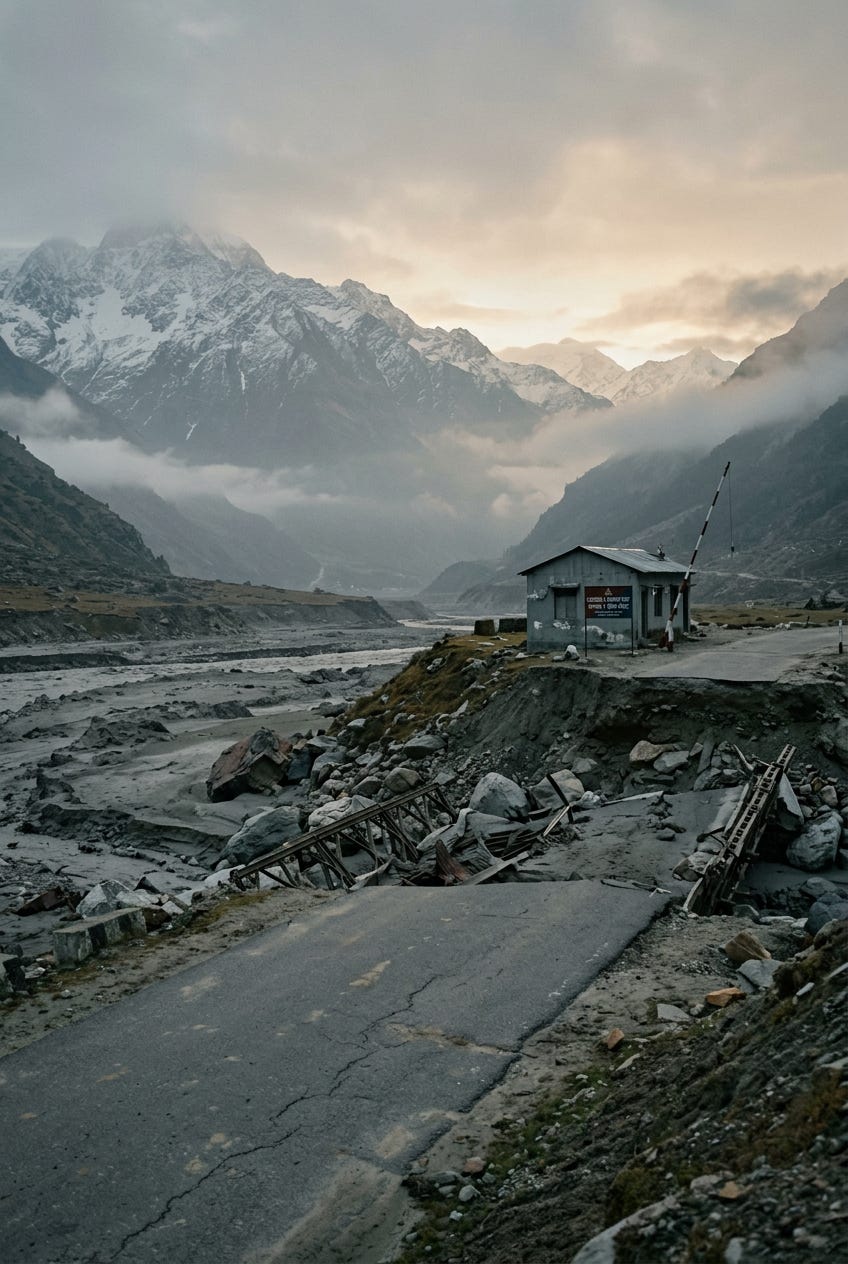
The obscure signal this week is a Nikkei line about Indian hydropower that reads as an environment story and is actually a balance sheet story. Nikkei reports India's hydropower push is raising natural disaster fears in Kashmir, filed in the same days a Himalayan glacier collapse killed more than 700 people in Nepal, left over 3,000 missing, and destroyed a border crossing on the Tibet frontier. The wires will treat these as separate items. The bondholder should not, because the Nepal event is the live demonstration of the tail the Indian build-out is underwriting, in comparable geology, at comparable altitude, within the same month. The plumbing runs three ways. Large hydropower assets in a seismically and glacially unstable zone sit on state and quasi-sovereign balance sheets, and the loss event is not depreciation, it is one structure and its downstream valley in an afternoon. Installed capacity assumed available in a power plan is not capacity that is available. And a country whose crude dependence just hit a record has every incentive to accelerate domestic generation into that same terrain, which makes the energy security problem and the disaster exposure one risk with a policy loop connecting them.
Where This Desk Is Willing to Wait
The Standing Book is due, and eight weeks of open positions deserve an evidence check rather than a restatement. The Pakistan Asymmetry has been open since early July on the premise that no cash-attached package had been signed; subsequent evidence has now moved the question, because a package is being proposed in a form that changes the creditor mix rather than merely adding to it, which is a different problem than the one the stance was opened against. The India strategic leg has been held Constructive since early July and the evidence has broadly supported the industrial policy thesis, but this week delivered the first adverse print on the external leg, and this desk records that rather than narrating around it. Indonesia stays Cautious and Nigeria stays Constructive, both explicitly rolled forward on unchanged premises, because neither produced new evidence this week in either direction. On Africa more broadly, both mandatory feeds carried almost no coverage, and an absence of evidence is recorded here as an absence, not as confirmation.
We see Asymmetry in Pakistan external debt, rolled forward from The Uncontested Candidate with the downside branch now specified rather than merely heavier. Bilateral cash reconciled against the existing financing assurances still resolves this favourably; an actual issuance priced into a sub-three-month import cover position, replacing the commitments the Fund's arithmetic depends on, resolves it the other way and would take this to Cautious.
We Prefer the front end of the EM hard-currency curve over duration, rolled forward with the invalidation rewritten to match the mechanism that is actually live. The old test was whether a second joint intervention held. The real test now is whether frontier duration holds its bid through a confirmed Bank of Japan hiking path rather than into one.
We are Constructive on Indian sovereign and equity on the strategic leg, unchanged in direction and horizon. The industrial policy case has not been disturbed this week, but a third governance departure at a systemically important Indian financial institution would put this under review rather than merely on watch.
We are Constructive on the Indian rupee and external accounts, with the horizon shortened from three months to four weeks. The stated invalidation has not fired and this desk will not pretend a different trigger counts, but a second vulnerability channel opened that was not in the original thesis, and the honest response is a shorter leash rather than a manufactured reversal.
We are Constructive on Korean duration and the won, opened this week as the deliberate non-defensive position in an otherwise cautious book. A central bank raising to 3% on demand strength with the current account behind it is this week's cleanest configuration, and the Fund's own risk assessment names the offset, a semiconductor slowdown driven by softening AI-related demand, which it rates a medium likelihood.
We are Cautious on Sub-Saharan African commodity exporters, rolled forward on an unchanged premise and explicitly on no new evidence. The Fund's regional framing of a funding squeeze beneath 4.1 percent headline growth is the reason this stance persists, and broadened Chinese import demand in commodity volumes rather than high-tech goods remains what would change it.
What Patience Is Worth Until It Is Gone
Every sovereign balance sheet carries one asset that never appears on it, which is the willingness of its creditors to wait. It is not marked, not rated, and not quoted, and it is usually discovered only in the week it is gone. Islamabad is proposing to trade it for a cleaner dependence statistic and a better sentence in a press release, and the market is applauding the statistic. Tokyo is discovering that a currency the current account no longer supports has to be defended with policy instead, and policy is slower and larger than intervention. Delhi is finding that a barrel sourced cheaply from a sanctioned supplier carries a price that is not denominated in dollars. And in a Himalayan valley, several hundred kilometres from any trading floor, a glacier demonstrated what happens when something everyone had priced as slow stops being slow. Patience is not a virtue on a balance sheet. It is a position. Nobody rings a bell when it is surrendered. The bill arrives when the waiting stops.
What Would Change Our Mind
A confirmed Bank of Japan hiking path that frontier duration absorbs. If Tokyo delivers a real tightening cycle and EM back-end spreads hold rather than gap, the carry unwind this desk has flagged since The Seven-Day Regime was the wrong risk and the front-end preference should be retired.
Pakistan's support arriving as reconciled bilateral cash. A disbursement that lands against the EFF's existing financing assurances, rather than a market issuance that replaces them, resolves the Asymmetry favourably and removes the creditor-mix problem this dispatch is built on.
India's August trade figures when they print next month. A crude import bill that shows diversification away from the record Russian share would restore the Fund's diversified-import assumption; a further concentration alongside any named enforcement action against Indian refiners takes the external leg to Cautious.
Regards,
Sovereign Dispatcher