


KEY TAKEAWAYS
Indonesia's State Enterprise Export Monopoly Has Graduated From News Flow to Mainstream Institutional Consensus in a Single Week. The Economist's characterisation of Indonesia's president as 'erratic' and his seizure of the country's commodity export apparatus, flagged in last Sunday's Admission Cycle, removes the reversibility assumption from the base case: the IMF Article IV's market-based commodity revenue projections now face a structural variance premium the spread has not priced.
India's Structural Deterioration Has Entered Its Fifth Consecutive Phase, Moving From Financial Markets and Middle-Class Energy Stress to the Elite Institutional Layer. The Economist's depiction of Modi giving India's elite 'a taste of the bad old days' is a licence raj signal, not a political commentary; Rubio's simultaneous LNG pitch to Modi in New Delhi confirms India's energy shock has graduated to US Secretary of State-level diplomatic intervention, which is not a market-solvable problem.
Ethiopia's IMF Programme Conditionality and Abiy Ahmed's Imperial Fiscal Ambitions Are Now in Direct, Public Collision. An Economist leaders section editorial on a sovereign in active G20 Common Framework restructuring is a material credit event: the DSA modelled fiscal restraint; the editorial documents imperial expansion. Both cannot simultaneously be operative.
The BOJ's Fifth Consecutive Rate Hike Confirmation Signal From Nikkei Continues to Compress the Yen Carry Premium Funding Frontier Duration. With JGB 10-year yields confirmed at 2.75% as documented in last Wednesday's Real Yield Verdict, and Nikkei now reporting rising bond yields pressing on the BOJ taper plan, the carry exhaustion timeline is accelerating without offsetting spread repricing in Pakistan, Egypt, or Kenya.

The Conference Table and the Invoice
The market's frame this week was Shangri-La and APEC, where the security architecture of the post-Iran-war order was being tentatively reassembled. Japan and the Philippines elevated their defence ties. Vietnam's To Lam stressed balance at Shangri-La between the great powers. Japan and China's trade chiefs held what Nikkei described as their first substantive exchange since the tariff dispute, on the sidelines of APEC. US-China trade talks were back in focus. Malaysia and Singapore printed export surges the consensus read as evidence that the AI boom is building a structural firebreak between sophisticated Asian economies and the Mideast shock. The market's conclusion: diplomatic architecture is advancing, the Iran war is a managed risk rather than a compounding one, and the two-tier Asia the IMF's 2026 Outlook identified as the structural bifurcation is delivering on schedule for the correct tier.
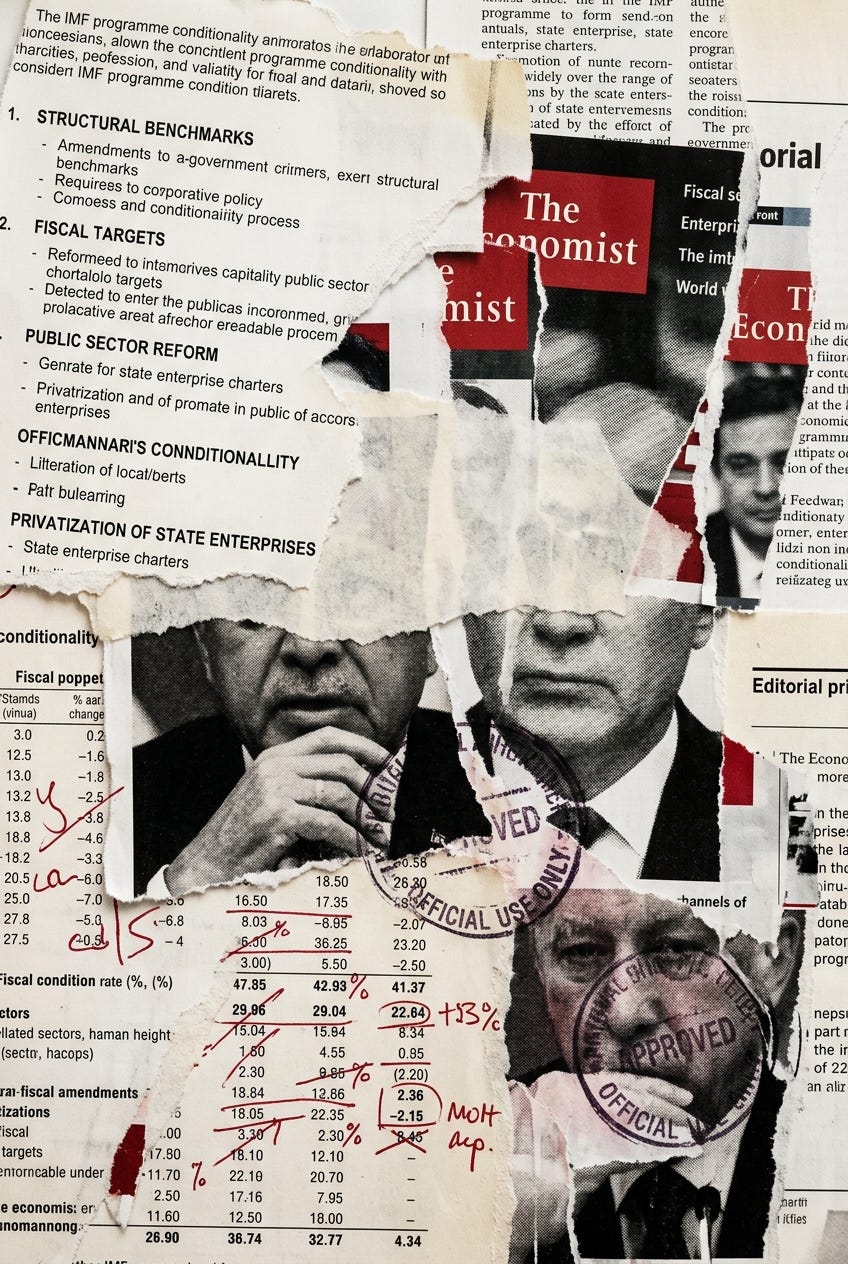
The Economist was publishing something different. In a single issue, the magazine devoted its leaders section to Ethiopia's Abiy Ahmed and his plan to remake his country in an imperial image, ran a story characterising Indonesia's president as 'erratic' and his seizure of the country's commodity export apparatus, and published a piece titled 'Narendra Modi gives India's elite a taste of the bad old days.' These are not three independent editorial decisions. They are three angles on the same structural thesis: that the market-based institutional frameworks the IMF's Article IV baselines modelled as structural constants are being systematically dismantled, and that the dismantling has now reached the institutional layer, the elites and editorial opinion-setters who previously absorbed the shock rather than transmitted it. The invoice that has been accumulating since the April 26th Compound Ledger has arrived at the door the market assumed was protected.
The Programme Assumptions That Did Not Survive the Week
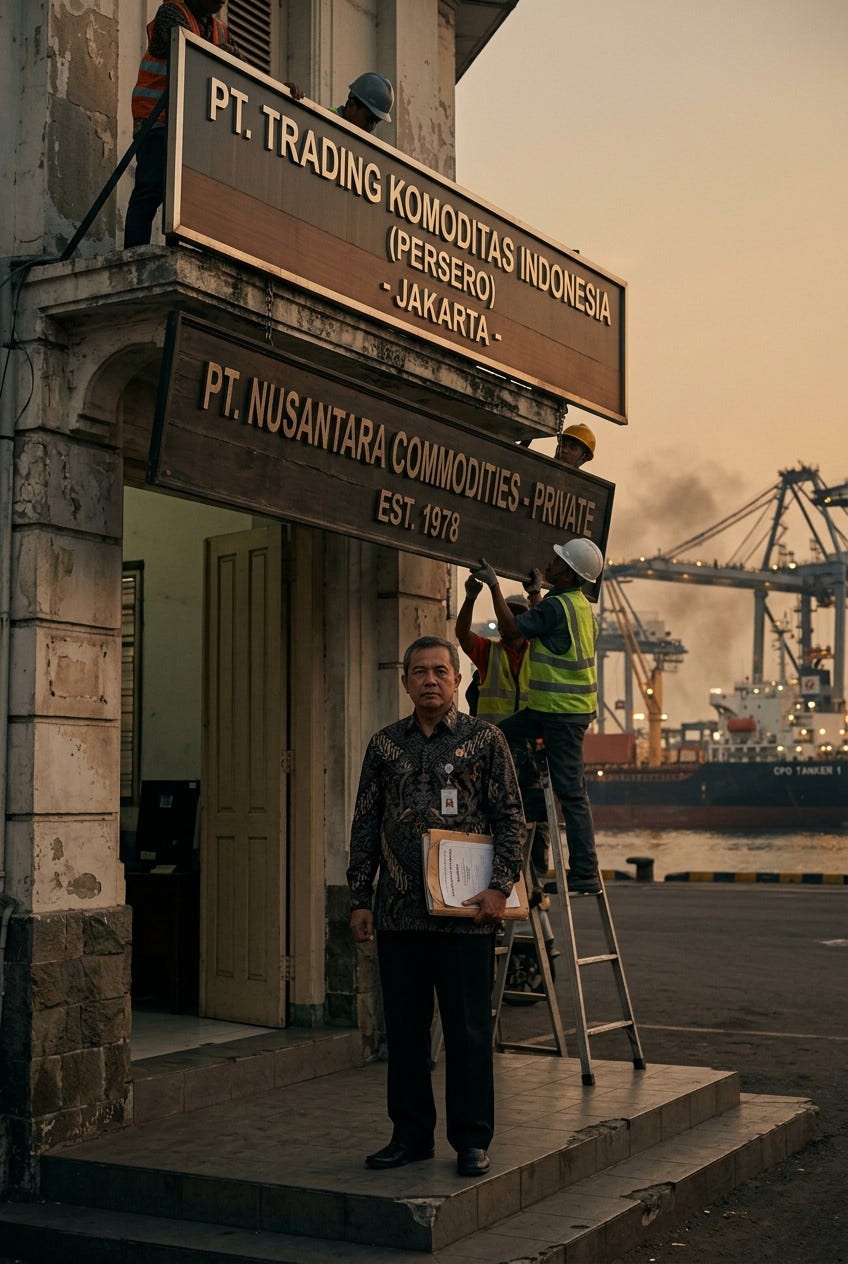
The IMF's Indonesia Article IV modelled commodity export revenues through competitive market-based private export channels, with fiscal projections premised on international market pricing for palm oil, thermal coal, and nickel without monopoly discount or transfer pricing leakage. The Economist's characterisation of Indonesia's president as 'erratic' and its description of his commodity export seizure confirms that what last week's Admission Cycle flagged as a potentially reversible announcement is now a structural fixture in mainstream institutional consensus. Three plumbing distortions compound from here: the state enterprise monopoly introduces transfer pricing risk when directing exports to bilateral partners at below-market rates; it introduces EU Deforestation Regulation compliance friction for palm oil, which accesses the highest-margin markets through private-sector certification chains; and it introduces an operational efficiency differential between state enterprise and private-sector commodity logistics that systematically widens revenue variance. The combined effect is a growing gap between the fiscal projections the Article IV uses as the spread's reference baseline, and the revenues the monopoly structure will actually deliver.
The IMF's Ethiopia ECF programme under the G20 Common Framework carries fiscal surplus targets and debt sustainability assumptions premised on expenditure restraint and an absence of new large-scale territorial or infrastructure ambitions. The Economist's leaders section characterisation of Abiy Ahmed as dreaming of remaking Ethiopia in his image carries three direct conditionality implications: military expenditure from territorial ambitions competes directly with the primary surplus targets the DSA assumed; bilateral creditor relations under the Common Framework are sensitive to political stability signals, and China as Ethiopia's largest bilateral creditor will price an Economist leader about imperial ambition into its restructuring posture; and the DSA's maturity wall assumptions require a constrained new liability trajectory that imperial infrastructure ambition structurally contradicts. Against this background, the BOJ's 10-year yield confirmed at 2.75% last Wednesday continues the carry compression documented since The Communiqué and the Conflagration. The yen carry trade that funds Pakistan, Egypt, Kenya, and Ethiopia duration is contracting on the funding side while conditionality risk expands on the asset side simultaneously.
The Route From Tokyo to the Restructuring Table
The transmission mechanism from Japan's monetary normalisation to Africa's frontier bond spreads has been documented across five consecutive Sunday dispatches from this desk, and the fifth week brings a structural convergence the prior four did not. As the BOJ's taper plan faces rising bond yield pressure confirmed for the fifth consecutive time in Nikkei, with JGB 10-year yields at 2.75% and described as pressuring the central bank's path, the yen funding cost for the carry positions that finance Pakistan, Egypt, Kenya, and Ethiopia duration is increasing at precisely the moment those credits are receiving the most significant negative structural signals of the current cycle. The carry trade was simultaneously pricing stability in the funding currency and in the asset. Neither is delivering that stability in the same week.
For the bondholder holding Indonesian or Indian duration, the week's significance is the Economist issue rather than the Shangri-La speeches. Indonesia's spread prices an Article IV that assumed competitive market-based commodity revenues. The Economist editorial confirmation places monopoly reversal in the low-probability category, which means every quarter the state enterprise operates below international market rates is a quarter in which fiscal revenue capture diverges further from the projection the spread was calibrated against. For India, the 'bad old days' framing is not editorial hyperbole; it references the licence raj era of state intervention in private economic activity that preceded the 1991 liberalisation, and the IMF April 2025 Article IV assumed that liberalisation framework as a structural constant. An Economist piece depicting India's elite receiving the licence raj signal means the structural constant has been questioned at the institutional opinion-formation layer. Five consecutive dispatches have documented the deterioration. Import cover has not recovered. The spread has not adjusted.
The Mispriced Sovereign Stack
We are Cautious on Indonesia external duration across medium-term maturities where the fiscal revenue variance from the commodity export monopoly creates a widening gap between projected debt service coverage and the coverage the current spread implies. The leading indicator remains the first state enterprise export contract: if it is directed to a bilateral partner at a discount to international market rates, the transfer pricing risk is confirmed and the Article IV projections require immediate revision.
We are Cautious, Phase Change on India sovereign duration and Indian-currency-adjacent assets. Five consecutive dispatches have documented a deterioration that has now reached the elite institutional signal layer. The IMF April 2025 Article IV is materially outdated across three dimensions simultaneously: current account assumptions, energy buffer operability, and institutional framework stability. Rubio's LNG pitch to Modi in New Delhi confirms the problem is above market-solution threshold.
We are Cautious, Escalating on Ethiopia restructured instruments. The collision between Abiy Ahmed's imperial fiscal ambitions and the IMF programme's DSA conditionality is not a tail risk; it is a direct contradiction now documented in the institutional consensus layer. An Economist leaders section editorial during an active G20 Common Framework restructuring is the editorial equivalent of a rating outlook change. Position for conditionality deviation rather than against it.
We Prefer short-duration positioning in the two-speed Asia cohort, specifically Malaysia and Singapore adjacent credits, where the AI export surge confirmed this week is organic rather than carry-dependent. This is the week's narrow constructive position in a note otherwise dominated by cautious calls: the structural bifurcation the 2026 Outlook identified is delivering for the correct cohort.
We are Cautious on yen carry-funded positions in Pakistan, Egypt, and Kenya duration. The BOJ's fifth consecutive rate hike signal from Nikkei means the carry exhaustion timeline documented since The Communiqué and the Conflagration is not abating. The EMBI at 241 basis points, eight basis points tighter than year-end 2025 despite a 19-year high in the US 30-year Treasury, remains the cycle's central mispricing.
The Quiet Before the Revision
There is a specific moment in every credit cycle that is identifiable only in retrospect: the moment when the analysis is complete and the spread has not yet moved. Institutional opinion formation is not instantaneous. An Economist editorial is processed by portfolio committees, validated by internal analysts, and eventually translated into position adjustments across weeks and months, not hours. The sovereign credit analyst's advantage is not speed; it is the willingness to complete the analysis before the spread does. This week, three institutional opinion-formation signals arrived in a single issue of the same publication. The market priced Shangri-La. It priced APEC diplomacy. It priced Malaysia and Singapore's export surge. The Economist chose its editorial priorities differently, and when the publication that forms conventional wisdom about frontier markets dedicates a single issue to three stories the spread has not priced, the analyst's responsibility is to trust the analysis rather than wait for the market to confirm it. The revision will come from Jakarta, from Addis Ababa, or from New Delhi, possibly from all three in the same quarter. The question the bondholder must answer now is not whether the invoice is real. It is whether the position is sized for when it arrives.
Regards,
Sovereign Dispatcher