

KEY TAKEAWAYS
The Liberation Day Analogy Error: The dominant sell-side framing this week — "this too shall pass," as ML's CIO letter explicitly argues — draws its conviction from the Liberation Day template of April 2025, where tariff-driven panic gave way to a rapid equity recovery. But tariff shocks are policy-reversible. A near-closure of the Strait of Hormuz, and its downstream disruption of Gulf methanol (40% of global supply), urea (43%), sulfur (44%), and ammonia (27%), is not. The damage channel is structural and molecular, not cyclical and negotiable.
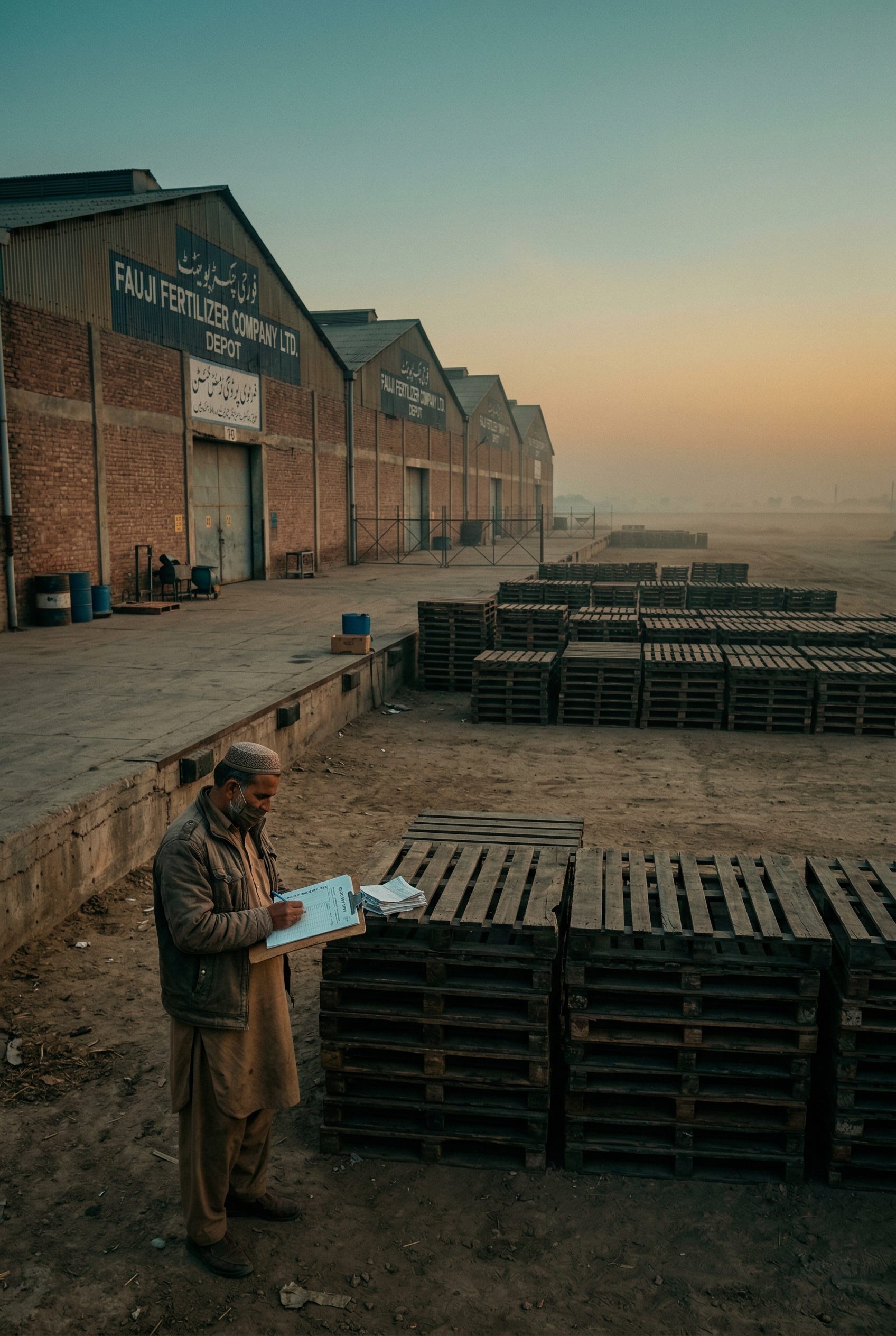
The Molecular Lag: ML's own data reveals the precise mechanism: 15% of global oil demand flows into petrochemicals — fertilisers, plastics, pharmaceuticals — that form the molecular foundation of agriculture and food systems. For EM sovereign balance sheets, this translates into ballooning food subsidy obligations that the IMF's pre-war fiscal baselines never modelled, and which will not appear in Q1 equity returns but will show up acutely in Q3 and Q4 fiscal accounts.
The EM Outperformance Mirage: JPMorgan's data shows MSCI EM returned +2.7% YTD while U.S. large cap lost 6.7% in 1Q26. This relative outperformance is overwhelmingly driven by Korea and Taiwan's AI-capex tailwind, not broad EM health. Strip out the AI supply-chain beneficiaries, and the underlying picture for fertiliser-importing sovereigns in South Asia and Sub-Saharan Africa is materially worse than the index implies.
The Central Bank Trap: BlackRock frames the key question of the moment with precision: the debate has shifted from "will central banks cut?" to "will their policy rates keep up with the rise in inflation?" For EM central banks already operating under IMF programme constraints — as we have tracked in Pakistan's Stand-By Arrangement — this is not an abstract question. It is a binding fiscal constraint with real sovereign credit implications.

THE LIBERATION DAY TEMPLATE
The dominant sell-side conviction this week can be summarised in four words from the Merrill Lynch CIO letter: "This too shall pass." The framing is deliberate and historically anchored. ML's Joseph Quinlan constructs a 100-year chart of the Dow Jones Industrial Average against successive crises — two World Wars, the Great Depression, COVID, Liberation Day — and observes that each period of acute volatility was succeeded by an economic revival. The argument is intellectually sound as a statement about the U.S. equity market's historical resilience. Its error is in its application to sovereign credit markets in EM.
BlackRock reinforces this normalisation thesis with its own data: the S&P 500 has lost ground for five consecutive weeks for the first time since 2022, yet their strategic recommendation is to use the dislocation to build thematic positions rather than reduce risk. Their tactical table is explicit: hard-currency EM debt is favoured due to "improved economic resilience, disciplined fiscal and monetary policy and a high ratio of commodities exporters." BofA echoes the theme, noting that their Bubble Risk Indicator has rotated from gold and silver — which sold off sharply in March — to Brent crude and Bloomberg commodities, now showing elevated bubble risk at WTI near $94-99/barrel and Bloomberg Commodity Index up 23.4% YTD.
JPMorgan's 1Q26 asset class recap confirms the anomaly that the Street is using to build its "resilience" case: commodities are up 23.4% YTD, MSCI EM is positive (+2.7%), and flash global PMIs remain expansionary at 52.4/51.1. This confluence of data points has given the sell-side permission to deploy what we call the Liberation Day Template — the belief that, as with tariffs in 2025, the initial panic will overshoot, the policy response will stabilise, and patient investors who stayed invested will be rewarded. This assumption deserves rigorous challenge from the IMF baseline.
THE FERTILISER FAULT LINE
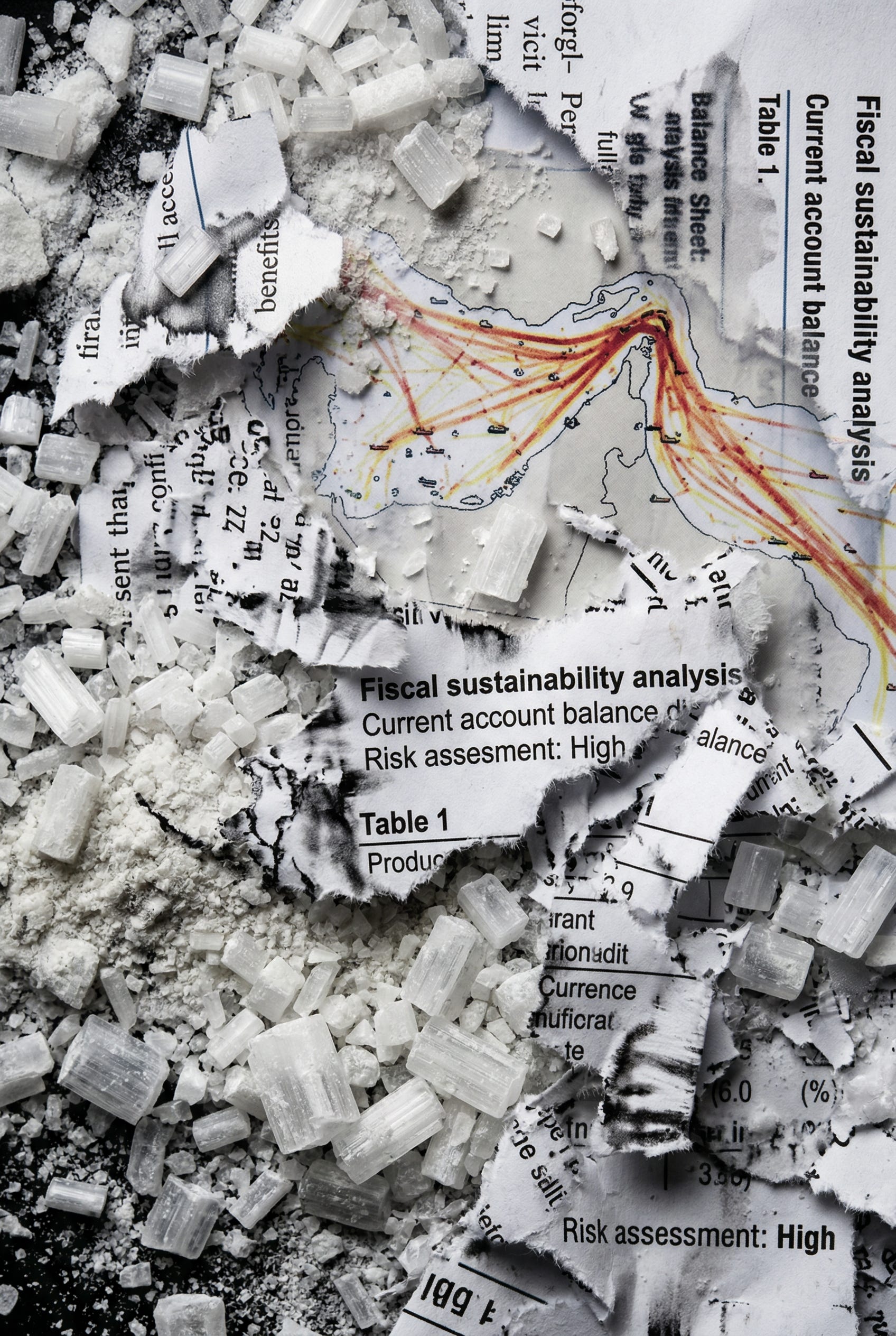
The IMF's October 2025 World Economic Outlook establishes a critical analytical distinction that the Liberation Day Template ignores: not all supply shocks are structurally equivalent. The WEO's chapter on Emerging Market Resilience examines the differential transmission of external shocks across sovereign balance sheets, distinguishing between demand-side shocks (where policy space and reserve adequacy provide genuine buffers) and supply-side molecular shocks, which embed themselves into food systems, agricultural input costs, and subsidy obligations that compound over quarters, not weeks.
Merrill Lynch's own analysis, intended to reassure investors, inadvertently provides the most precise diagnosis of the structural damage channel. Their CIO letter notes that the Gulf region accounts for 40% of global methanol supply, 43% of urea, 44% of sulfur, and 27% of ammonia — all critical inputs to the global fertiliser industry. Qatar alone accounts for 34% of global helium. The near-closure of the Strait of Hormuz, as confirmed by BlackRock, does not just disrupt oil flows. It disrupts the molecular supply chain for global agriculture. For energy-importing EM sovereigns that already carry food subsidy programmes — a group that includes Egypt, Pakistan, Nigeria, Morocco, Indonesia, and the Philippines — this creates an unbudgeted and growing fiscal obligation that the IMF's pre-war Article IV baselines do not model.
The IMF Ghana Article IV illustrates the operational mechanics of this vulnerability with unusual granularity. Ghana's programme already requires weekly reporting of FX intervention schedules, granular reserve data, and market intermediation ratios as a condition of its IMF engagement. The structural assumption embedded in these monitoring requirements is that reserve adequacy remains stable and food subsidy costs remain bounded. A sustained disruption to global fertiliser supply — affecting planting cycles for the 2026 harvest season — would blow through both assumptions simultaneously, forcing the IMF to revise its programme benchmarks at precisely the moment Ghana's balance of payments is under the most stress. As we flagged on Sunday, this dynamic of hidden off-balance-sheet sovereign pressure is the defining risk of the current cycle, not the headline oil price.
THE PROXY ECONOMIES AND THE SLOW BLEEDERS
The MSCI EM index's outperformance (+2.7% YTD versus S&P 500's -6.7%) is one of the most misleading data points in current market discourse. JPMorgan's own commentary identifies the driver: Korea and Taiwan are "benefiting from AI-related capex," and their index weight is sufficient to lift the EM composite even as the underlying economies of South Asia and Sub-Saharan Africa absorb the molecular shock. This is a Proxy Economy dynamic — the AI supply-chain beneficiaries (Korea, Taiwan, and to some extent India) are acting as a statistical shield for the index, concealing the accelerating deterioration in fertiliser-importing sovereigns whose fiscal arithmetic is deteriorating in real time.
The Proxy Economy divergence is not new — as we established in our Year Ahead Outlook, the global EM universe has been bifurcating between supply-chain beneficiaries and debt-service victims since the Liberation Day era. What is new in the first week of April is the speed at which the second cohort is falling behind. BlackRock explicitly notes that Japan and South Korea face "exposure to price swings and demand adjustments" on imported LNG, while "Europe has limited ability to reduce demand." For our asset class, this analysis must be extended further down the credit spectrum: India's CPI is already under pressure from energy costs per ML's data, the Philippines faces compounding pressure from a drop in tourism revenue and remittances (their own framing), and Pakistan's unbudgeted kinetic expenditure overhang — which we detailed in Sunday's dispatch — now intersects with a fertiliser import shock that could force the government to choose between maintaining IMF programme compliance and avoiding a domestic food crisis.
The Slow Bleeders — those sovereigns whose damage accumulates quarterly rather than daily — require a different analytical lens than the ones currently deployed by the Street. BofA's energy shock framing notes that "developing economies with higher food and energy shares in their consumption baskets are particularly exposed." This is structurally accurate but analytically incomplete. The damage mechanism for EM sovereigns is not just higher consumer prices — it is the interaction between price spikes, subsidy obligations, FX reserve drawdowns, and IMF programme conditionality. Morocco, whose Phosphates are a critical fertiliser input and which sits at a peculiar intersection of exporter advantage (phosphate pricing power) and importer vulnerability (natural gas imports for ammonia production), represents the most complex case. The clean narrative the Street is currently constructing — energy exporters win, importers lose — will prove too simple within two quarters.
CALIBRATING THE LAG PREMIUM
We are Cautious on hard-currency sovereign debt for countries in the molecular import cohort where food subsidy obligations are unbounded and IMF programme conditionality has not been updated to reflect post-war fiscal baselines. This includes Pakistan 2027s and 2029s — the IMF Stand-By Arrangement benchmarks were set before unbudgeted military expenditures, and fertiliser import shocks now threaten agricultural output heading into Q3.
We maintain Asymmetry in Egypt — the BlackRock and ML analysis reinforces our prior view that GCC inflows provide a near-term nominal cushion, but the IMF Article IV's external financing gap arithmetic has not improved. The current calm is a "Lag Premium" — the market is pricing in the GCC backstop, not the underlying solvency math. We prefer defensive positioning in the capital structure rather than duration extension.
We are Constructive on Morocco sovereign credit with a nuanced sectoral lens — Morocco's OCP Group position as a major phosphate exporter gives it a genuine fertiliser-cycle tailwind that is structurally differentiated from its peers. However, we note the gas import channel for ammonia production as a ceiling on upside. Morocco is the one country in the MENA/Africa universe where the energy shock has a complex two-sided exposure that warrants selective rather than wholesale positioning.
We are Overweight hard-currency EM debt as a category in line with BlackRock's tactical positioning — but explicitly disaggregate this from broad EM equity. BlackRock's stated rationale (commodities exporters, improved policy frameworks) applies to a subset of the index, not its entirety. We favour commodity exporters — particularly those with managed-float exchange rates and active IMF flexible credit line arrangements — over pure energy importers.
We are Cautious on EM local-currency sovereign duration in energy-importing Asia, particularly India and Philippines, where the energy-food pass-through is undermining the disinflation trajectory that local bond markets had been pricing. JPMorgan's 35bp rise in yields since year-start is the leading indicator of this compression.
We note that Ghana's IMF programme monitoring architecture — weekly FX reporting, granular reserve data — provides an early-warning system that is more rigorous than comparable African peers. We would not add duration here but acknowledge that the programme structure creates a disciplined feedback loop that reduces binary default risk relative to sovereigns operating without IMF oversight.
THE COST OF NARRATIVE CONVENIENCE
The most seductive trap in investing is not the false thesis — it is the true thesis applied to the wrong instrument. The ML CIO team is entirely correct that the U.S. economy has proven adaptive across a century of crises: two World Wars, a depression, a pandemic, a war in Iran. The S&P 500 returned 123% total return this decade despite all of it. That observation is not false. It is simply the wrong observation for a portfolio of sovereign credit instruments in economies where governments cannot print the reserve currency, cannot absorb molecular supply shocks through corporate pricing power, and cannot reset their fiscal programme benchmarks through earnings guidance.
The Liberation Day Template works for equity investors in the American economic ecosystem precisely because the U.S. possesses three advantages that define the EM condition by their absence: reserve currency issuance, corporate margin flexibility, and a consumer balance sheet resilient enough to absorb price pass-through. None of these conditions apply to the sovereigns we track. When ML reports that the dollar has gained 2% since the war began, it is confirming that the safe-haven gravity is pulling liquidity away from the very EM reserve buffers that the IMF's resilience thesis relies upon. The Molecular Lag will manifest not in Q1 earnings calls but in Q3 agricultural output data, Q4 fiscal accounts, and the 2027 IMF programme reviews.
The second-level question — the one Howard Marks would insist upon — is not whether the energy shock will eventually pass, but whether the sovereign credit instruments we hold will survive the passage intact. In the interval between the shock and the recovery that ML promises, EM sovereigns are drawing down reserves, expanding food subsidy programmes, revising fiscal targets, and renegotiating IMF benchmarks under conditions of maximum external pressure. The price of patience is not evenly distributed. For U.S. equity investors, patience is rewarded by compound growth. For energy-importing EM sovereigns navigating a molecular supply disruption without policy space, patience is a luxury they cannot afford. Position with precision. The shock will pass. The question is who survives the interval.
Regards,
Sovereign Dispatcher