


KEY TAKEAWAYS
Japan's Yields Hit a 30-Year High as Tokyo Recalls Its Capital. The finance minister urged the world's largest pension fund to invest at home, withdrawing the frontier's marginal funder by price and policy at once.
Indonesia Drew a Second Index-Downgrade Warning, Doubling the Trapdoor. S&P Dow Jones followed MSCI onto the reclassification watchlist, so forced passive selling can now be set off by either committee.
China Dropped Its Urban Jobs Target for the First Time in Decades. Removing the employment anchor lowers the import-demand floor beneath every African commodity exporter the IMF built on a mid-decade recovery.
Asian Risk Appetite Cracked as Korea Slid Into a Bear Market. The Kospi fell more than 20% from its June peak, the sell-the-good-news reversal that drains the frontier's marginal buyer first.

The Applause for a Withdrawal
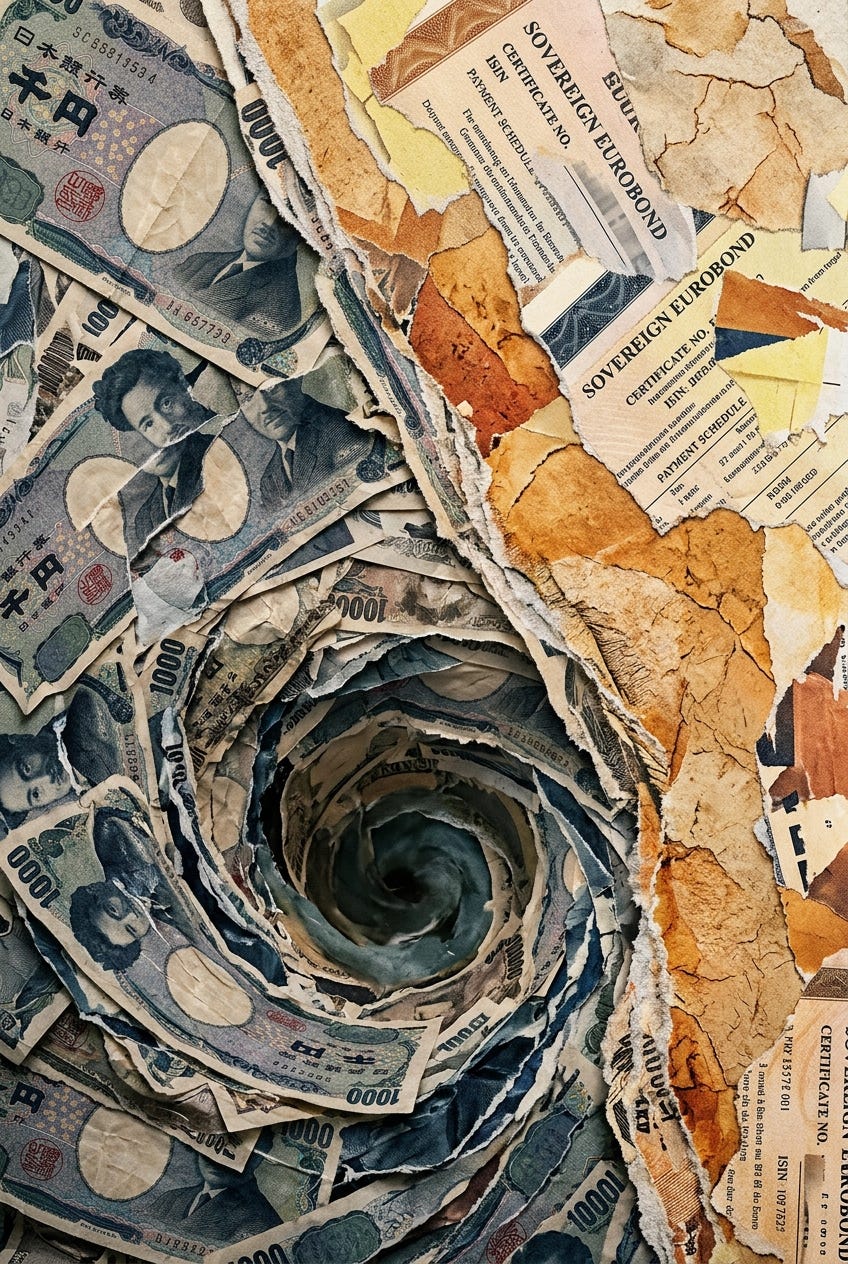
The market spent the week applauding Japan's normalization, and applauded a withdrawal of its own funding without noticing. For five dispatches this desk has tracked Tokyo, from the permanent carry floor of The Crossed Threshold, to the contested one of The Fiscal Counterweight, to the intervention watch of The Unpriced Discontinuity. This week the FT reported Japanese borrowing costs at a 30-year high, the steepest JGB yields since 1996, alongside wages rising in exactly the way the Bank of Japan wants in order to keep lifting rates. The consensus filed both as a domestic success, the world's most durable deflation trap finally closing. That is the reading exactly backwards. A 30-year high in the home government's bond yield is not a Japan story, it is a frontier story, because it reprices the single most important funding leg in the emerging-market complex. The crowd cheered a homecoming. It did not price who gets left on the shore.
The Repatriation Beneath the Rate
The plumbing is simple once the direction of Japanese capital is put at the center of it. Japan is the world's largest creditor nation, and its institutional savings, the pension funds, the life insurers, the banks, are the marginal funder of global duration, recycled outward into everything from US Treasuries to frontier eurobonds. The yen-carry funding leg that prices Pakistan, Egypt, and Ethiopian sovereign duration is set against JGB yields, so when those yields reach a 30-year high on fears over long-term spending, the funding cost beneath the entire frontier complex rises with them. The term premium and curve steepness the Bank of Japan spent this cycle trying to anchor are re-steepening under debt fears, not compressing. The IMF's Japan Article IV assumed gradual normalization paired with fiscal consolidation, and, more fundamentally, assumed Japan keeps exporting capital in an orderly way. The delivered combination inverts both halves of that assumption at once.
This week Tokyo added a policy signal to the price signal, and that is what changes the character of the risk. Finance Minister Satsuki Katayama publicly urged the Government Pension Investment Fund, the largest pool of retirement savings on earth, to invest more at home, and the yen, JGBs, and Japanese equities all firmed on the call. Read the two together and the marginal funder of the frontier is being drawn home by price and called home by policy in the same week. Last week's risk in The Unpriced Discontinuity was a discontinuity, a Ministry of Finance intervention snapping the yen from its 40-year low and unwinding the carry in a single session. This week's risk is quieter and does not need intervention to bite. It is a steady structural drawdown, a maturity wall refinanced into a pool that is both more expensive and shrinking, and every frontier DSA that silently assumes cheap, plentiful Japanese outflow is being invalidated a basis point at a time.
The Shore the Ebb Leaves Dry
Follow the ebb to where it lands first, and it lands on the credits funded directly off the yen. The bondholder in Karachi, Cairo, or Addis Ababa does not read the wage data as good news, because Pakistani, Egyptian, and Ethiopian sovereign duration is priced against precisely the funding leg that just reached a 30-year high in Tokyo. Pakistan is the sharpest case, and it rolls forward The Proxy this desk named earlier: Islamabad has widened its diplomacy from the US-Iran track to mediating between Libya's two rival administrations, still betting external financing on a peace it has not signed. A wider diplomatic footprint is not a disbursement. The maturity wall and the energy-import bill do not pause for a communique, and this week they sit above a funding cost climbing structurally rather than cyclically. The market keeps pricing the hope of a signature while ignoring the rising price of the rollover beneath it.
The ebb also withdraws support one layer up, from the credits that depend on foreign capital simply staying put. Indonesia drew its second index-downgrade warning this week, S&P Dow Jones following MSCI onto the reclassification watchlist, which does not repeat the first warning so much as double the trapdoor: forced passive selling can now be triggered by either committee, layered on the first trade deficit in six years logged a fortnight ago and the run of currency-defense rate hikes that preceded it. China lowers a different floor. Dropping its urban jobs target for the first time in decades and pressing agencies to strip triple-A ratings from riskier borrowers, Beijing is conceding a growth-and-credit slowdown that erodes the import-demand assumption beneath Angola, Zambia, and the African exporter DSAs the IMF built on a mid-decade recovery. Three withdrawals, one direction. The tide is going out on more than one beach.
The Crack in the Backstop
The signal the wires will miss this week sits on the creditor's side of the ledger, not the debtor's. The FT reported that Saudi Arabia is blocking or delaying payments to UAE accounts, with transfers from the kingdom to businesses and individuals in Dubai repeatedly returned or held up, which the paper read as a sign of economic tension between the two Gulf paymasters. The mainstream files this as a rivalry story between two rich states. The sovereign-credit read is sharper, because Saudi Arabia and the UAE are the invisible backstop under the frontier's most fragile IMF programmes: Gulf deposits, rollovers, and direct investment are what have repeatedly filled the financing gaps in Egypt and Pakistan when the multilaterals alone could not, and the Fund's programme arithmetic assumes those bilateral flows are reliable. Two paymasters returning each other's payments are less likely to move in concert on a fresh Egyptian deposit or a Pakistani rollover, and that hesitation lands at the exact moment the frontier's other funding source, the yen-carry leg, has reached a 30-year high. A hairline crack in the backstop, disguised as blocked bank transfers.
The Book Against a Receding Tide
We are Cautious on Indonesia across the capital structure, consistent with the stance this desk has held since The Tightening Gyre and now hardened rather than repeated. The second downgrade warning from S&P Dow Jones doubles the passive-outflow trapdoor MSCI opened, and it lands on a balance of payments already in its first trade deficit in six years. A settled review at both providers without delistings, alongside a restored surplus, would flip it; a reclassification at either would not.
We see Asymmetry in Pakistan, binary on financing it has not signed, rolled forward from The Fiscal Counterweight with one change. The yen-carry funding leg beneath the credit has moved against it, reaching a 30-year high while the signature stays absent. A cash-attached Gulf or multilateral package is a one-off inflow the spread underweights; another month of borrowed peace over a costlier rollover only widens the downside.
We remain Constructive, selectively, on India, consistent with last week, and the scheduled catalysts have multiplied. A first India-Japan defense codevelopment pact and Amazon becoming the largest foreign investor in India's AI sector are strategic inflows that behave differently from fickle carry, sourced from Japan even as Japanese capital broadly turns home. The binding risk stays a single weather variable. A normal monsoon validates the stance; a failed one turns food inflation into a rate-hold dilemma.
We are Cautious on the Sub-Saharan commodity-exporter tier, through the China floor, a new framing to the book this week. Beijing dropping its urban jobs target for the first time in decades lowers the import-demand assumption beneath Angola, Zambia, and Nigeria that the IMF baseline priced. A credible China demand restart flips the read; continued managed deceleration keeps the floor drifting down.
The Water Was Already Leaving
A tide does not announce itself at the turn. The water looks highest in the moment just before it begins to leave, the quay is busiest, the boats sit level, and nothing on the surface says the ebb has started. That is the market this week. Spreads sit near the tightest of the year, the developed-market data reads benign, and the crowd reads a 30-year high in Japanese yields and a call to bring the pension money home as a domestic success, a country finally growing up. Five weeks ago this desk called the BOJ carry floor permanent, then corrected itself to contested, and now watches the funder simply turn for home. The lesson the cycle keeps teaching is that funding leaves before price does. The frontier's spread still quotes high water. The tide has already turned. Read the direction of the capital, not the level of the coupon. The water was leaving while the harbor still looked full.
What Would Change Our Mind
A sustained pullback in JGB yields from the 30-year high, or a Bank of Japan move to cap the long end, either of which reopens the yen-carry funding pool the frontier borrows against.
A signed, cash-attached Gulf or multilateral financing package for Pakistan or Egypt that proves the bilateral backstop still functions despite the Riyadh and Abu Dhabi payment friction.
GPIF's next quarterly portfolio disclosure, showing whether Katayama's repatriation call is converting into actual domestic reallocation or remaining rhetoric.
Regards,
Sovereign Dispatcher