

KEY TAKEAWAYS
The Reclassification Premium: BofA's global economics team has performed the most important analytical service of the week: explicitly reclassifying the Iran conflict as an "energy shock" (gas, fertilizers, petrochemicals) rather than an oil shock. This reclassification has direct sovereign credit implications. IMF Article IV baselines for Egypt, Kenya, Bangladesh, Pakistan, and the Philippines were all built on oil sensitivity models, not gas-to-grain transmission models. The spread between official fiscal projections and actual fiscal outcomes is widening in real time.
The Exporter Dividend Is Masking the Importer Discount: BlackRock correctly identifies that EM's aggregate resilience is disproportionately sourced from Latin American net energy exporters. The danger is that this aggregate narrative is suppressing the sovereign spread widening that should be occurring in Asia and Sub-Saharan Africa's energy-importing frontiers. As we flagged in the April 1st note, EM outperformance is a compositional illusion, not a structural validation.
The Fertilizer Subsidy Trap: For sovereigns that import natural gas as a feedstock for domestic fertilizer production (Egypt, Morocco, Bangladesh, Pakistan), the shock is not a one-time import cost, it is a recurring budget line. When governments absorb the price at the farm gate through subsidy regimes, the IMF's external account projections remain clean while the fiscal deficit silently deteriorates. This is the sovereign credit risk that does not appear on energy screens.
The VIX Dislocation Warning: BofA's volatility desk is flashing a signal that the broader market should not ignore: the VIX remains well above realized volatility (mid-20s versus mid-teens) with an unusually flat curve. In a sovereign credit context, this elevated risk premium, combined with mean-reversion rather than trend persistence in U.S. equities, signals that the carry-trade window that has sustained EM flows is narrowing. The next sovereign funding stress will arrive faster than current spread levels imply.
The Consensus Pivots, But Only Halfway
The dominant sell-side narrative this week has undergone a partial, and therefore dangerous, evolution. BlackRock's Investment Institute, writing from the perspective of the Middle East and APAC mandate, correctly identifies the Strait of Hormuz closure as generating "disparate effects across EM economies," explicitly distinguishing between energy importers and exporters. The observation is accurate. Latin American sovereigns that are net energy exporters are, as BlackRock states, "far less exposed", and their relative resilience is propping up the MSCI EM aggregate. BofA's global economics team goes further, identifying the specific transmission mechanism: the global economy is "far more sensitive to natural gas and fertilizers" than it was to previous oil shocks, with Europe and developing economies disproportionately exposed. This is sophisticated analysis.
The gap in the Street's current framing is not in the diagnosis, but in the dosage. Both BlackRock and BofA are articulating the importer-exporter dichotomy at the macro aggregate level, but neither is following the transmission chain into the sovereign fiscal balance sheet of specific frontier credits. When BofA writes that "developing economies with higher food and energy shares in their consumption baskets are particularly exposed," the implicit audience is equity and rates investors thinking about growth and inflation. The sovereign credit investor needs a different calculation: what does a persistent 15-20% increase in natural gas import costs do to Morocco's fertilizer subsidy line? What does a urea price spike do to Egypt's already-stretched food security budget? The Street is providing the taxonomy; it is not yet doing the sovereign balance sheet math.
The Hidden Arithmetic of the Subsidy State
The IMF's own knowledge base reveals the precise structural vulnerability that the sell-side's importer-exporter framing elides. IMF research on EM fiscal resilience consistently identifies "energy and food price shocks" as the primary channel through which external volatility transforms into sovereign credit events, not through GDP compression, but through subsidy obligation expansion. The mechanism is straightforward but systematically underpriced: when a government in Bangladesh, Morocco, or Egypt faces a gas-to-grain price spike, it has a binary choice. It can pass the price through to consumers, triggering social instability and political risk, or it can absorb it through energy and food subsidies, triggering fiscal deterioration. Both options carry sovereign credit risk. The market is currently pricing neither.
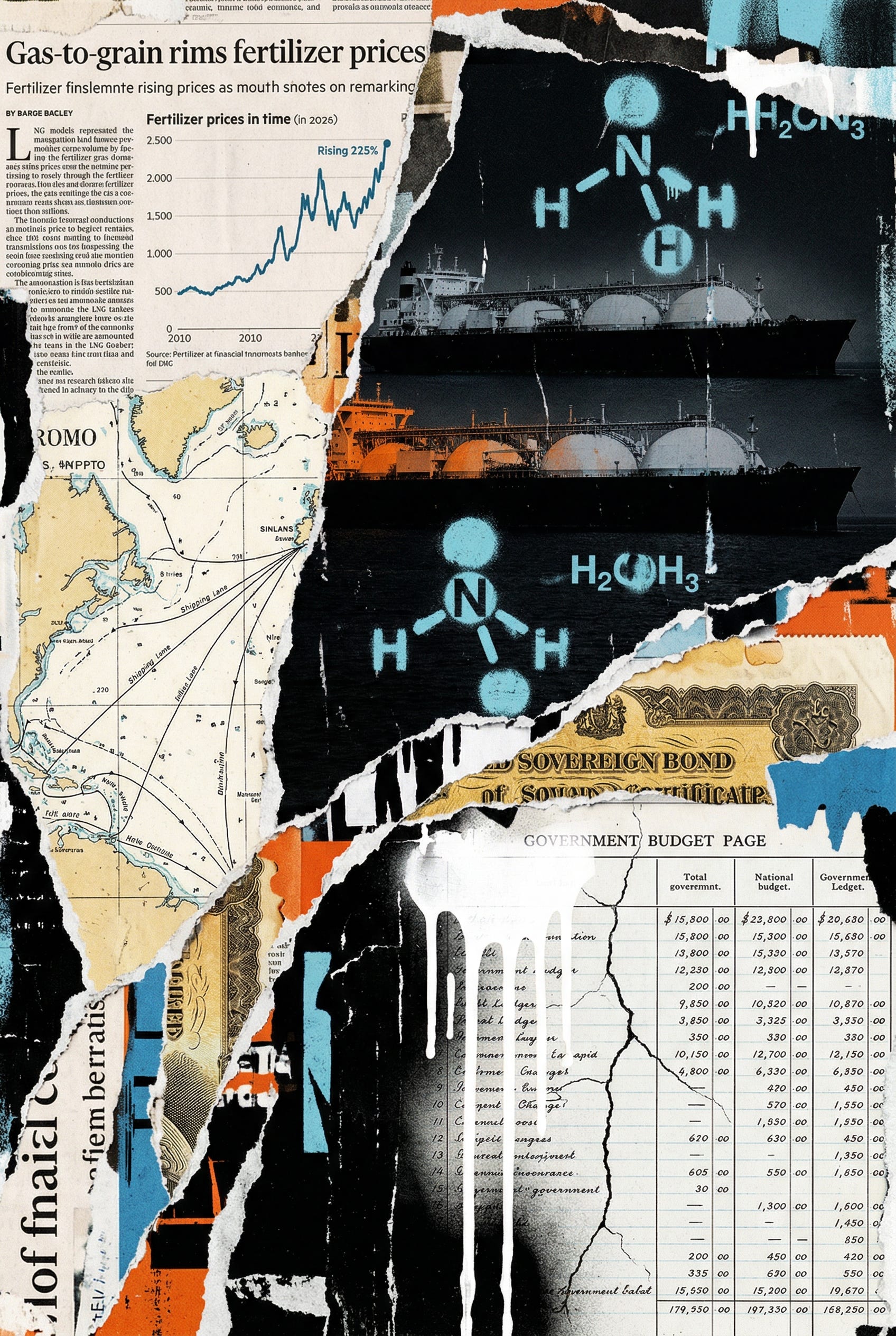
The fertilizer transmission belt is the specific channel that makes this shock structurally different from a standard oil price event. Natural gas accounts for roughly 85% of the cost of producing ammonia, which is the primary feedstock for urea and nitrogen-based fertilizers. For sovereigns with domestic fertilizer industries (Egypt's Abu Qir, Morocco's OCP Group for the domestic market, Pakistan's Fauji Fertilizer), a gas price spike is not just an import bill, it is a production cost crisis for domestically manufactured fertilizers, requiring governments to choose between allowing farm input prices to spike or defending domestic food security through subsidy transfers. As stated in our April 1st note, "the damage channel is structural and molecular, not cyclical and negotiable." This week's BofA framing validates that thesis.
The IMF's December 2025 Ghana review provides an instructive case study in how this fiscal damage is systematically obscured. Ghana's program design includes granular FX reserve reporting requirements precisely because the Fund understands that energy price shocks tend to manifest in sovereign balance sheets through off-balance-sheet instruments, FX swaps, encumbered assets, and derivatives-based borrowing that keeps the headline deficit within program ceilings while accumulating structural vulnerabilities. As we flagged in late March with Senegal's €650mn in undisclosed derivatives positions, this pattern of "shadow fiscal deterioration" is endemic to the francophone African sovereign universe, and the gas-fertilizer shock is the specific catalyst that activates it.
The Importer Ladder: From Cairo to Dhaka to Manila
The geography of sovereign vulnerability has three distinct rungs, and the market is currently pricing only the top one. The first rung, EM energy importers with significant external financing needs and shallow reserve buffers, is broadly identified and partially priced. Egypt, Pakistan, and Bangladesh occupy this tier. But the second rung, sovereigns with domestic fertilizer or petrochemical industries that act as "gas amplifiers", is almost entirely unpriced. Morocco's OCP Group, the world's largest phosphate exporter, relies on imported sulfur and natural gas inputs; a sustained gas price shock compresses OCP's export earnings precisely as the government needs OCP's dividends to fund subsidy expenditures elsewhere. This "energy echo", where the primary shock creates a secondary shock in the same sovereign's most important export revenue source, is a structural asymmetry that the Street's importer-exporter binary completely fails to capture.
The third rung is the most insidious: the stagflation trap in sovereigns with overextended monetary frameworks. As the Bangko Sentral ng Pilipinas governor's recent admission of being caught between "a rock and a hard place" confirmed, a phrase we noted in the April 5th Sunday dispatch as a sovereign credit signal, not just a monetary policy observation, the gas-fertilizer transmission arrives in countries like the Philippines through imported inflation in energy and food, forcing a central bank already managing currency weakness to choose between growth and price stability. The IMF's Article IV for the Philippines explicitly models "elevated global commodity prices" as a key downside risk to the 2025-2026 fiscal baseline. That downside scenario is now the central scenario, and the spread premium attached to BSP policy credibility is fundamentally mispriced.
The Exporter Dividend, The Importer Discount, and the Gaps Between
We are Overweight Latin American high-yield sovereign credit on a relative basis, acknowledging that the energy exporter dividend identified by BlackRock is real, structural, and likely to persist for as long as the Hormuz corridor remains constrained. Ecuador, Colombia, and to a lesser extent Mexico are beneficiaries of a terms-of-trade shift that the IMF's current account frameworks fully validate. This is not a narrative trade; it is a balance-of-payments arithmetic trade.
We maintain our Cautious stance on Asian energy-importing frontiers, with the Philippines, Bangladesh, and Sri Lanka occupying the highest-conviction cautious positions in that order. The Philippines faces the three-way compression of gas import costs, fertilizer subsidy obligations, and BSP monetary policy paralysis. Bangladesh has the most acute natural gas import dependency in the region relative to fiscal buffer capacity. Sri Lanka's post-restructuring fiscal framework has zero tolerance for subsidy obligation expansion.
We are Cautious on Morocco's external bonds despite the OCP halo effect that has historically supported spread compression in the name. The gas-sulfur amplification dynamic described above is not yet priced, and a sustained Hormuz constraint will test the inverse correlation between OCP earnings and Morocco's sovereign financing needs that has historically been the key credit pillar.
We maintain Asymmetry in Pakistan, where the IMF Stand-By Arrangement creates a structural floor but where the geopolitical rent from the US-Iran intermediary role is producing fiscal illusions. As stated in the March 29th dispatch, unbudgeted military and border expenditures are the concealed deterioration variable. The gas-fertilizer shock adds another layer of unbudgeted subsidy pressure that the program's 0.1% of GDP fiscal adjustment path was not designed to absorb.
We are Constructive on Egypt's EM trajectory on a 12-month horizon but acknowledge that the near-term subsidy management risk is elevated. Egypt's natural gas production from the Zohr field provides a partial domestic buffer, but the power generation and fertilizer sectors still require significant gas imports, and social stability risk from food price pass-through constrains the government's pricing flexibility. The IMF's program ceiling on subsidy expenditures will be tested.
The Ledger Beneath the Screen
In sovereign credit, the most durable alpha does not come from predicting which shock arrives, but from knowing which balance sheet was already too fragile to absorb the shock that did. The Iran conflict and its gas-fertilizer transmission path did not create the vulnerability in Bangladesh, Morocco, or the Philippines. It merely activated pre-existing structural weaknesses that the IMF had identified, that the sell-side had acknowledged in footnotes, and that markets had ignored in the rush toward EM beta. BofA's explicit reclassification of this as an energy shock, not an oil shock, is the intellectual foundation the market needed to perform the correct sovereign credit analysis. What remains is the willingness to act on the implications before they appear in fiscal data rather than after.
The VIX flat curve and mean-reversion dynamic that BofA's volatility desk is flagging is not an equity market observation, it is a sovereign funding warning. When uncertainty is elevated and momentum is fragile, carry-funded EM flows are the first to reverse. The sovereigns that depend on those flows to finance their gas-fertilizer subsidy obligations are doubly exposed: to the primary shock and to the liquidity withdrawal that follows. The margin of safety in current spread levels reflects neither dimension of this compounding risk.
Regards,
Sovereign Dispatcher