


KEY TAKEAWAYS
Takaichi Launched Japan's Largest-Ever Fiscal Roadmap Days After the BOJ Hiked. The 2.3 trillion dollar plan reopens the yen-carry funding floor this desk called permanent just one week ago.
The BOJ Tightened Into Below-Target Inflation Under Washington's Pressure. Japan's May core inflation printed below the bank's own target in the same week Treasury Secretary Bessent was credited with pushing the hike.
MSCI Deferred Its Indonesia Downgrade Verdict Rather Than Delivering It. The index trapdoor stays open, and the reforms Jakarta needs to avoid frontier status could themselves trigger the delistings that justify it.
Pakistan Is Pricing Financing It Has Not Secured on a Peace Deal Not Yet Signed. Islamabad's elites are betting the army chief's US-Iran diplomacy unlocks support, a binary the spread has not decomposed.

When Deferral Reads as Relief
The market spent the week treating three postponements as three resolutions, and rewarded itself for the confusion. As this desk documented in The Sixty-Day Assumption, the EMBI Global Diversified compressed to 229 basis points on the Iran framework, the tightest since January, on the proposition that the structural risks of the last quarter had been administratively cleared. Nothing this week disturbed that posture. The consensus read Takaichi's investment roadmap as pro-growth, the MSCI delay on Indonesia as downgrade risk removed, and Pakistan's diplomacy as financing all but secured. Each of these is a deferral wearing the costume of a verdict. A spending plan is not growth until the bonds are absorbed, a delayed index review is not a reprieve until the review concludes, and a peace push is not a disbursement until someone signs. The price action implies a best case in which every open question settles in the holder's favour. The dollar near a one-year high, which we flagged last Wednesday, is the quiet tell that the relief is borrowed rather than earned.
The Bond Supply Beneath the Carry Floor
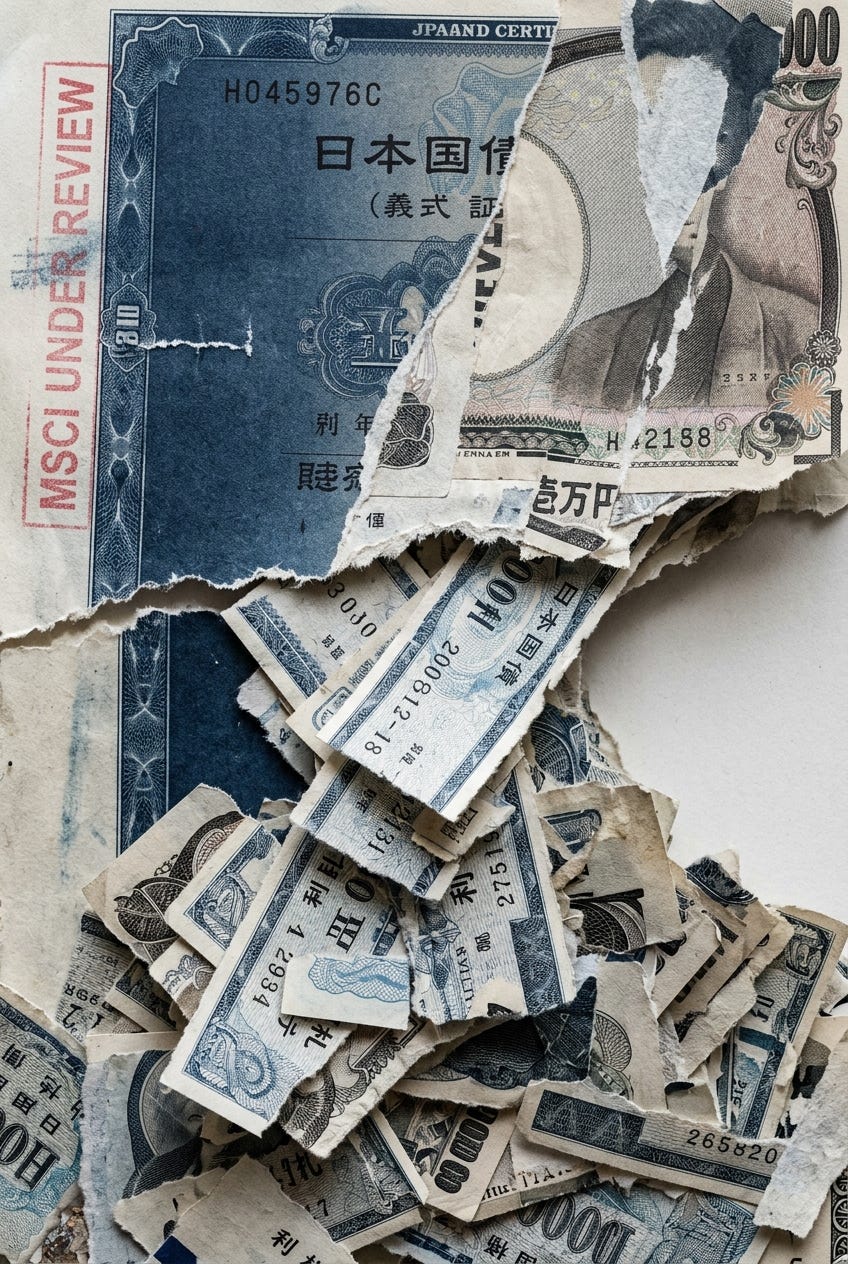
The decisive event of the week was not the hike the market had already filed, it was the spending plan that quietly recontested it. Prime Minister Takaichi set out a 2.3 trillion dollar public and private investment roadmap over fourteen years, which the FT read plainly as fiscal expansion by a government already carrying the developed world's heaviest debt load. That expansion is financed by new JGB issuance, and new supply at the long end pressures the term premium and steepens the curve the Bank of Japan just tried to anchor. The frontier sits directly downstream. The yen-carry funding leg that prices Pakistan, Egypt, and Ethiopian sovereign duration is set against JGB yields, and higher JGB yields raise a funding cost the BOJ had already lifted to 1%. The IMF's Japan surveillance assumed normalization paired with fiscal consolidation, precisely so the two instruments would not work against each other. The delivered combination is the inverse: a tightening central bank and a spending government, pulling the same funding floor in opposite directions.
The contradiction sharpens when the inflation data and the politics are added to the plumbing. Japan's May core inflation stayed below the BOJ target in the very week the bank raised rates, and the Nikkei reported that Treasury Secretary Bessent, the so-called shadow governor, had pushed for the move, which means the hike's domestic economic logic is contested and its external pressure is visible. If Takaichi's issuance forces JGB yields higher, the BOJ may be compelled to cap the long end to absorb the supply, a step that would re-loosen policy and undercut the hike it just delivered. Either path raises the variance of the frontier's funding cost: let yields run and the funding leg tightens further, or cap them and the carry regime the desk called permanent last week loosens again. The bondholder refinancing a maturity wall this quarter is no longer pricing a monetary variable, but a political one, and the spread quotes the level while ignoring the variance. The Article IV map assumed a settled funding path. The weather just unsettled it.
Jakarta's Held Verdict and Islamabad's Borrowed Peace
The same logic of suspension governs the two frontier credits that moved this week, and in both the absence of a verdict is being mistaken for the absence of risk. MSCI did not downgrade Indonesia, it delayed the decision and asked for further evidence of reform, which leaves the trapdoor flagged in The Crossed Threshold neither sprung nor closed but held open over a market that has already raised rates 100 basis points in six weeks. The reflexive trap is now embedded in the remedy itself: to keep its emerging-market classification, Jakarta must impose larger free-float and transparency requirements, and analysts warn those same requirements could push companies to delist, shrinking the investable universe the index measures. Reforming to retain the float can erode the float. Passive money cannot position around a review with no date, and active money discounts the tail, so the uncertainty premium accrues on every Indonesian asset while no single price formally moves. For the bondholder, this is risk held in suspension, compounding quietly.
Pakistan presents the Proxy in its purest form, a sovereign attempting to convert geopolitical positioning into balance-of-payments relief without touching its own fiscal accounts. The FT reports Islamabad's elites pinning their hopes on the army chief's push for a US-Iran settlement that could unlock financial support, a wager that diplomatic goodwill substitutes for primary-balance discipline. But the deal is unsigned, the Strait of Hormuz that the Sixty-Day Assumption noted opens only on paper, with demining alone running thirty days, and the energy import bill pressuring Pakistan's reserves persists until physical supply normalizes. Against this stands the one frontier credit manufacturing its own catalysts rather than awaiting them: India enters July with a UK trade deal taking effect and the Jio listing pipeline live, concrete confidence signals a draining capital account would not produce, offset only by a late monsoon that threatens the rural demand of a workforce nearly half employed in agriculture. The frontier now sorts into those awaiting a verdict, those borrowing one, and those writing their own.
The Suspension Premium
We are Cautious on Indonesia across the capital structure. The deferred MSCI verdict converts a discrete event into a prolonged uncertainty discount, and the reform path carries a self-defeating delisting mechanism that no rate adjustment offsets. There is no clean resolution that does not cost Jakarta either the classification or the float.
We see Asymmetry in Pakistan, binary on the US-Iran financing track. A signed settlement with attached support from Washington, the Gulf, or the multilaterals is a one-off inflow the spread underweights; a stall leaves a dense maturity wall untouched while diplomatic capital is spent on an outcome Islamabad does not control.
We are Constructive, selectively, on India into the UK deal and Jio window. The positive catalysts are concrete and scheduled while the principal risk is a single weather variable, the textbook asymmetric setup. A normal monsoon validates the rupee defense; a failed one turns food inflation into a rate-hold dilemma.
We Prefer the North Asian tech corridor over the generic commodity tier. SK Hynix's 29 billion dollar US listing and Singapore's 38% export surge confirm the two-speed split, though the record Korean equity volatility and property mania are the froth signals to respect, not chase.

What Accrues While the Verdict Waits
The most expensive error in sovereign credit is not misreading a verdict, it is mistaking a postponed one for a favourable one. A week ago this desk wrote that the BOJ had stamped a permanent floor under the frontier's funding cost, and seven days later a new prime minister reopened the question with the largest spending plan in his country's history. That is the lesson the cycle keeps teaching at the moment the consensus most wants to ignore it: in a market this richly priced, nothing is settled, things are only deferred, and the interest on a deferred risk is paid by whoever was told the matter was closed. The MSCI verdict is suspended, not dismissed. The Iran financing is promised, not wired. The carry floor is contested, not permanent. Each of these accrues a premium the spread declines to quote, and the bill arrives not when the verdict is bad but when the market discovers it was never actually delivered. Price the variance, not the headline. The settlement that never came is the one that costs the most.
Regards,
Sovereign Dispatcher