


KEY TAKEAWAYS
The BOJ Hiked to 1% for the First Time Since 1995, Converting the Carry Threshold This Desk Tracked for Nine Dispatches Into Settled Fact. Deputy Governor Uchida delivered under a hospitalized Ueda; the yen-carry funding floor for Pakistan, Egypt, and Ethiopia duration is now structural, not conditional.
Indonesia and the Philippines Raised Rates Simultaneously to Defend Currencies, the First Synchronized Emergency Tightening in Southeast Asia Since 2018. Two central banks acting in the same week against the same energy shock is a regional capital-account drain, not local management.
MSCI Flagged "Limited Transparency" in Indonesian Markets and Warned of a Potential Downgrade to Frontier Status. The reclassification risk arrives on top of four consecutive weeks of escalating defensive action, threatening forced passive selling atop active capital flight.
China Retail Sales Sank for the First Time Since Covid, Breaking the Consumption Floor That Anchored Every Commodity-Exporter DSA on the Watchlist. The IMF assumed a mid-2026 recovery; mid-2026 arrived with the first negative print since the pandemic.

The Orderly Hike That Changed the Plumbing
The Bank of Japan delivered 1% on June 16, and the consensus declared it priced, orderly, and absorbed. The Nikkei confirmed what this desk tracked from The Tightening Gyre through The Guidance Vacuum: Deputy Governor Uchida fronted the announcement under a hospitalized Ueda, the BOJ stated it will stop reducing monthly bond purchases from next year, and the market moved on. But the headline calm masks the plumbing reality that nine consecutive dispatches built toward. The carry trade that funded frontier sovereign duration from Karachi to Lagos was priced against a BOJ that had signalled but not delivered. It has now delivered. And in the same week, the hawkish shift in US rates upended global currency bets, with expectations of a Fed rate rise triggering a reversal in emerging market and commodity currencies. The carry arithmetic is being compressed from both ends, Tokyo raising the funding cost and Washington raising the destination cost, and the frontier sits between them. As we noted in The Settlement Lag, the meetings ended on time but the structural debt did not. The funding debt has now been stamped with a permanent new floor.
The Synchronized Perimeter and the Index Trapdoor
What began as India's solo defensive reflex in The Tightening Gyre has become a regional formation. The RBI held rates and exempted bond taxes three weeks ago. Bank Indonesia hiked off-cycle the following week. This week, Indonesia and the Philippines raised rates simultaneously to combat an energy shock and shore up currencies that the FT identifies as the region's worst-performing this year. Three central banks, three consecutive weeks, three distinct defensive levers, all responding to the same capital-account drain that the BOJ's 1% threshold intensified. The IMF Article IV for each sovereign assumed on-cycle, measured policy adjustments; all three have now broken their own calendars or frameworks to defend exchange rates. The synchronized tightening is itself the signal the spread is not pricing: this is not competent local management, it is the frontier's defensive perimeter contracting under stress that exceeds the assumptions the Fund modelled.
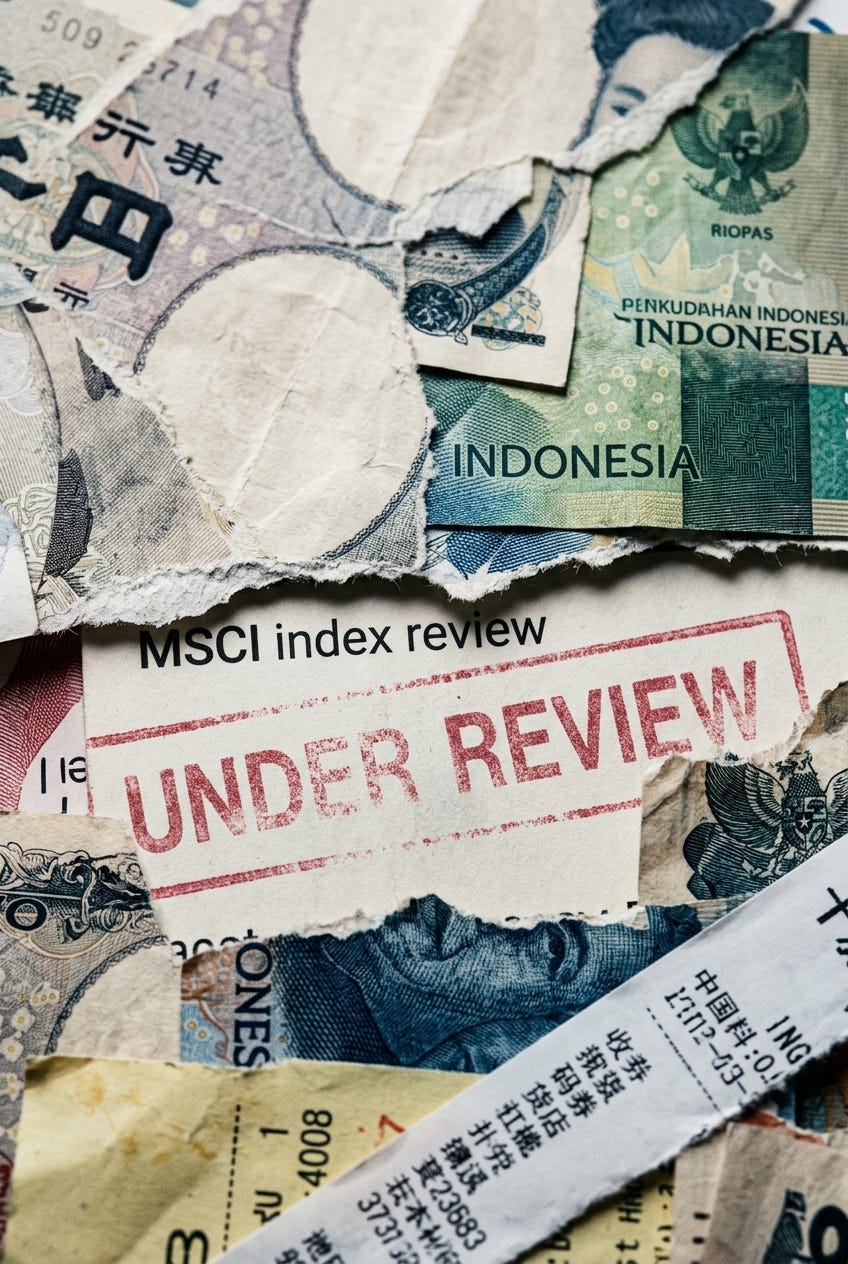
The MSCI warning on Indonesia transforms the monetary story into a structural capital-flow event. MSCI flagged "limited transparency" in Indonesian markets and warned it could downgrade the country from emerging to frontier status. If the reclassification proceeds, passive index funds tracking the EM benchmark must mechanically sell Indonesian equities regardless of fundamental value, and that forced selling arrives on top of the active foreign outflows already underway. This is the reflexive doom loop this desk has tracked across four consecutive dispatches: the May 24 Admission Cycle flagged the state enterprise export monopoly distorting revenue, the June 7 Tightening Gyre confirmed the six-year-low trade surplus and corruption arrests, the June 15 Guidance Vacuum saw the off-cycle emergency hike, and now the MSCI warning adds index-reclassification risk to a sovereign already hemorrhaging capital. The rate hikes raise domestic refinancing costs without stemming the outflow; the MSCI review threatens to accelerate it. Import cover compression continues while the Prabowo governance backlash provides the political catalyst that links the fiscal credibility gap to the transparency concern.
The Demand Floor That Cracked in Beijing
China retail sales sinking for the first time since Covid is not a domestic headline, it is the removal of the demand floor beneath the entire frontier commodity complex. Indonesian coal, Zambian copper, Mongolian coking coal, Nigerian oil, all price off Chinese import demand. The FT's declaration that China's economic comeback has hit a wall arrives at the precise moment the IMF WEO assumed a consumption recovery would be underway. The investment slump deepening alongside the retail contraction means both halves of domestic demand are now contracting simultaneously, a configuration the Fund's spring 2026 baseline did not contemplate. For the bondholder in Lagos or Lusaka, this is not a China story. It is the evaporation of the revenue assumption that underpins their debt sustainability analysis. The commodity channel transmits Beijing's consumption failure directly into the fiscal math of every resource exporter on the watchlist, and it arrives at the worst possible moment: when those same sovereigns are refinancing under permanently higher DM funding costs.
The divergence within China is itself a signal the consensus is misreading. Factory-gate prices remain elevated from the Hormuz energy supply disruption while retail demand collapses, the stagflationary configuration where rising input costs meet falling end-demand. As we documented in The Settlement Lag, the PPI-CPI gap was already the biggest in nearly four years; this week's retail print confirms the consumer side of that gap is widening, not stabilising. The EU's decision to delay trade confrontation with China over fears of retaliation removes the external pressure that might have forced Beijing into a stimulus pivot. Meanwhile Iran's ships are heading homeward and the Strait may be reopening, but the structural damage is already embedded in the pipeline: producer prices transmit with a lag, and the cost pass-through from months of elevated Hormuz disruption will compress Chinese exporter margins through the third quarter regardless of whether crude stabilises. Singapore's 38 percent export surge, driven by AI demand, is the mirror image of this contraction, the ASEAN region bifurcating into a tech-surplus corridor that thrives independently of the commodity cycle and a commodity-deficit tier that absorbs every shock.
The Refinancing Ledger
We are Cautious on Indonesia across the capital structure. Four consecutive weeks of escalating defensive action, culminating in a synchronized regional rate hike plus an MSCI downgrade warning, create a reflexive loop where rate hikes to defend the currency raise borrowing costs that deepen the slowdown that accelerates the capital flight the hikes were designed to stop. The MSCI review timeline is the structural catalyst; any reclassification triggers mechanical passive selling that no policy rate adjustment can offset. Duration exposure carries index-reclassification risk the spread does not reflect.
We are Cautious on China's commodity-export dependents, specifically Indonesia coal, Zambia copper, and Nigeria oil. The first negative retail print since Covid breaks the consumption-recovery assumption that anchored every commodity-exporter DSA on the watchlist. The IMF mid-2026 baseline is now contradicted by the data. Until Beijing signals a fiscal stimulus response, the demand floor for frontier commodity revenues remains absent, and the revenue assumptions in those DSAs carry more variance than the spreads price.
We see Asymmetry in India, binary on the Jio IPO outcome. The blockbuster Jio filing tests whether India can still attract discretionary foreign capital under triple stress: the RBI's ongoing rupee defense, the Iran war energy premium, and a late monsoon threatening the rural consumption anchor that employs 42 percent of the workforce. A well-subscribed IPO validates the defense and buys the RBI time; a cold reception confirms the capital drain has broadened from fixed income to equity. The three-week window where subscription demand and the monsoon trajectory compress simultaneously is the event to position around.
We Prefer the ASEAN tech corridor over the commodity corridor. Singapore's 38 percent export surge on AI demand, alongside Taiwan and South Korea's chipmaker momentum documented in The Tightening Gyre, confirms the two-speed Asia thesis from the 2026 Year Ahead Outlook. The tech corridor operates independently of the energy shock and the China consumption failure; the commodity corridor absorbs both. The intra-regional capital reallocation from commodity peers to tech peers is the structural trade the headline ASEAN narrative continues to miss.

The Price of a Permanent Number
The most dangerous moment in a carry regime is not when the threshold approaches but when it is crossed and the market declares it absorbed. Nine dispatches tracked the BOJ's path to 1%, through The Tightening Gyre's preliminary positioning, The Guidance Vacuum's communication risk, and The Settlement Lag's institutional confirmation. The threshold is now a settled number on a central bank's balance sheet, and the consensus has filed it under "priced." But priced at the headline level and priced at the plumbing level are two different claims. The frontier sovereign that refinances this quarter does so against a funding floor that did not exist last quarter, a destination-rate curve that has shifted hawkish, a China demand anchor that has cracked, and an MSCI index machinery that is actively reviewing whether to reclassify one of the region's largest markets. The spread quotes a world where each of these developments was absorbed individually. It has not yet quoted the world where they compound. The carry regime has crossed its threshold. The refinancing arithmetic has changed. The market will price the compound eventually. The only question, as it always is in frontier credit, is whether the repricing arrives gradually through the curve or suddenly through an event the consensus currently treats as tail risk. The history of sovereign credit suggests the answer is rarely gradual.
Regards,
Sovereign Dispatcher