

KEY TAKEAWAYS
India Has Crossed the Line From Anticipated Stress to Active Deterioration. As tracked across the April 26th Compound Ledger and last Sunday's Load-Bearing Defection, the Iran war energy shock was the IMF's most consequential modelling gap for Asia's largest economy. This week, FT confirmed the thesis has moved from anticipatory to active, with investors dumping Indian assets and the rupee in freefall against energy import costs the April 2025 Article IV never priced.
The BOJ June Rate Hike Signal Has Received Its Second Consecutive Data Confirmation. As flagged in last Sunday's dispatch, the hawkish hold with three dissenting members and Governor Ueda's explicit rate hike language was a carry-funding regime change, not a one-week story. March wage growth published this week is described by FT as "supportive of a June rate rise," and the carry structures funding Pakistan, Egypt, and Kenya duration remain priced against accommodation that is now explicitly closing.
China's 14% Export Surge Is Simultaneously the Market's Convergence Narrative and the Evidence Against It. Trump-Xi summit optimism is pricing trade war de-escalation as the week's dominant macro signal, but China's April export jump confirms that US tariffs have done nothing to dent manufacturing output while energy-importing EM continues to deteriorate. The bifurcation is widening. The single EMD spread that covers both cohorts is not.
Uzbekistan's London IPO Is the Week's Canary From the Stans. The FT Lex column endorsed a Central Asian frontier credit accessing London equity markets, a positive capital access signal for a category the IMF's Central Asia REO has consistently flagged as institutionally constrained. The question the bondholder must ask now, before the spread compresses further, is whether Uzbekistan's institutional reforms have genuinely caught up with the market's access premium, or whether yield-seeking capital has temporarily suspended its own discount.

The Summit Narrative and the Rupee Floor
The market spent the week constructing a convergence narrative around the approaching Trump-Xi summit, pricing trade war de-escalation as the dominant macro signal and positioning accordingly across EM equities. China's economic chiefs held what Nikkei described as a "candid" call before the summit. China's April exports printed at 14% year-on-year. The consensus read was that the two largest economies are approaching a grand bargain resolving the tariff architecture of the past two years. This is the consensus view. The sovereign credit analyst's job is to ask what the narrative is leaving on the table.
The narrative it is leaving on the table is India. While equity desks positioned around the Trump-Xi meeting and Asian equity indices printed new highs, the Nikkei 225 at a record peak and Samsung surging to a $1tn market cap, FT was simultaneously characterising India as "not a country to be invested in" as a direct result of the Iran war energy shock. Investors are dumping Indian assets. The rupee is sliding. Multinational back offices and IT services operations face disruption. The IMF's April 2025 Article IV projected India as the fastest-growing major economy at 6.2% GDP growth, using energy import costs calibrated to a pre-Iran-war baseline. Neither assumption is currently operative. The convergence narrative being priced around the summit is real for China. For the energy importer universe, India, Philippines, Vietnam, and Kenya, the divergence is accelerating, not resolving.
The Import Bill That the Article IV Never Wrote
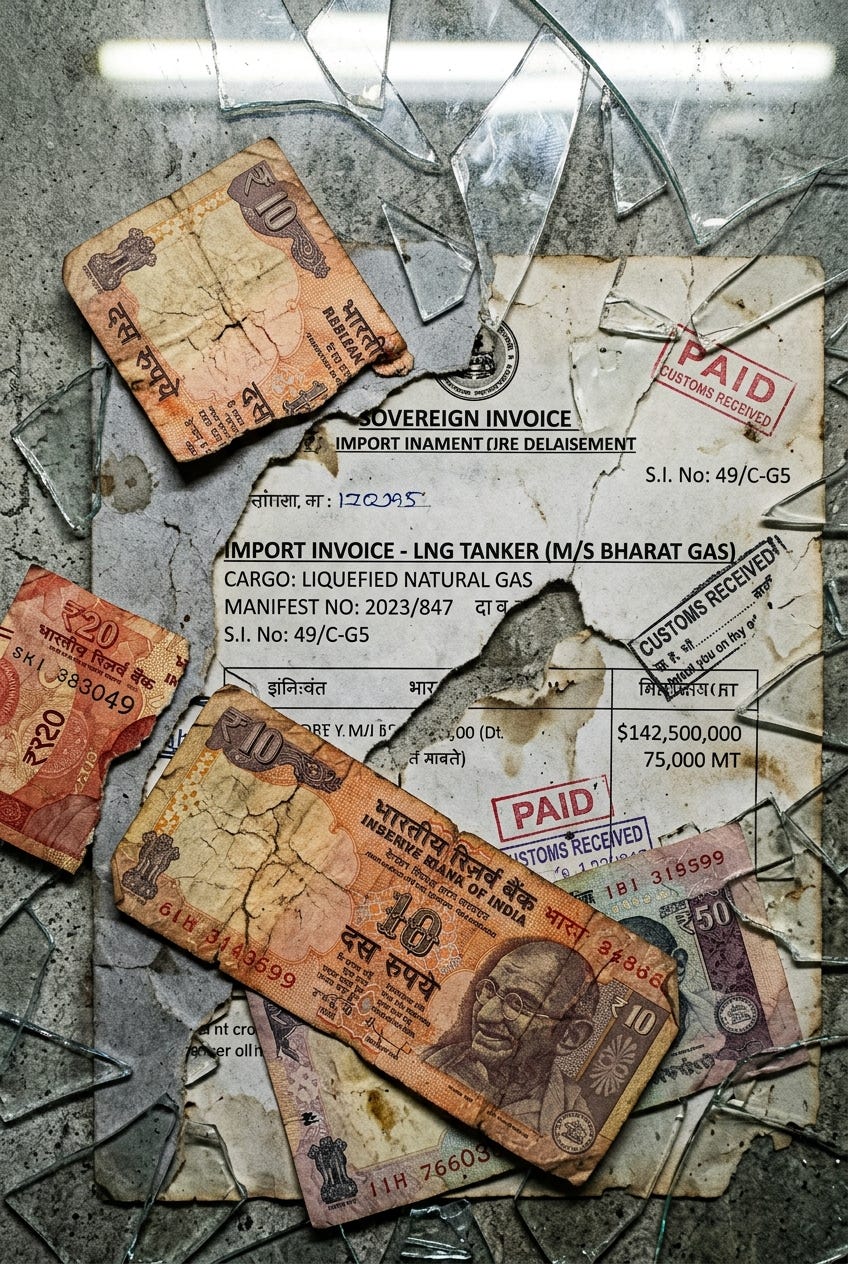
India's balance-of-payments mechanics have moved beyond the IMF's modelled parameter range, and the plumbing implications are arriving in the FX market rather than in a ratings action or a Fund staff paper. The April 2025 Article IV projected India's current account deficit at approximately 1.9% of GDP, using energy import cost assumptions calibrated to a pre-Iran-war baseline. Rupee depreciation compounds the import cost pressure in a self-reinforcing loop: a weaker currency amplifies the cost of each barrel or LNG cargo, which widens the current account further, which puts additional downward pressure on the exchange rate. As we tracked in the April 26th Compound Ledger, the Reserve Bank of India faces the same structural dilemma it faced then, defend reserves to stabilize the currency or permit further weakness and absorb the inflationary consequence. Import cover risk is moving toward the 9-month threshold. Modi's BJP West Bengal landslide is a political positive that provides zero balance-of-payments relief. The market is pricing the landslide. It is not pricing the threshold.
The BOJ transmission channel into this deteriorating picture is the second structural pressure point the market has priced as a one-week story but which is now in its second consecutive week of data confirmation. Last Sunday's Load-Bearing Defection described the BOJ's hawkish hold as a carry-funding regime change. This week's March wage data, described by FT as "supportive of a June rate rise," is the quantitative confirmation. The carry structures that fund duration positions in Pakistan, Kenya, Egypt, and high-yield frontier EM were built on an assumption of continued BOJ accommodation. Wednesday's Wrong Proxy dispatch documented the EMD spread at 243 basis points, compressing on the back of index returns driven almost entirely by Korea and Taiwan. That tightening is occurring simultaneously with a BOJ normalisation trajectory that has now received two consecutive data confirmations. The spread does not reflect the energy importer BOP deterioration, and it does not reflect the carry funding cost trajectory. Both are live.
The Resource Race and the Shock Absorber Gap
Japan's Africa tour and India-Vietnam's rare-earth agreement this week are not diplomatic headline stories, they are the simultaneous resource diversification races of two economies that have read the same structural lesson from the Iran war and are acting on it through different bilateral channels. Japan's government is seeking deeper involvement in Angola's oil and mineral sectors, a move that provides Angola with bilateral relationship depth the sovereign spread does not currently reflect. India and Vietnam have signed a defense and minerals agreement covering rare-earth ties, reflecting the same logic: secure the supply chains that the Iran war has demonstrated can be interrupted. For the Angola bondholder, Japan's explicit bilateral interest is an external backing signal worth monitoring. For the bondholder differentiating Vietnam's shock absorption capacity from the Philippines, as we began tracking in the April 26th Compound Ledger, this rare-earth agreement is another brick in the bilateral infrastructure wall that Vietnam is building as a managed response to energy import stress.
The ASEAN shared fuel reserve announcement reflects the same structural lesson being translated into collective action, but collective agreements take time to operationalise and provide no balance-of-payments relief in the current quarter. ASEAN leaders announced the creation of a shared fuel reserve in response to Iran war energy insecurity, while simultaneously boosting oil imports from Brunei, Libya, and the US. These are the correct structural responses to the lesson that single-source energy dependency creates fiscal risk. They do not, however, resolve the current account pressures accumulating in the Philippines and Vietnam at the speed of the oil price. Fast-moving indicators, per FT, are now showing that effects of the Gulf war have "fallen more sharply among energy importers than in the US." Collective regional architecture and bilateral rare-earth deals are the right medium-term hedges. They are not the Q2 balance-of-payments answer.
The Divergence Register
We are Cautious on India across the capital structure. As tracked since the April 26th Compound Ledger, the IMF Article IV modelling gap on energy import costs is confirmed in FX market flows. The spread has not moved. Political tailwinds from Modi's BJP dominance provide narrative cover, not balance-of-payments relief.
We Prefer reduced duration in high-carry EM frontier credits. The BOJ June rate hike signal has now received two consecutive weeks of data confirmation. Pakistan, Egypt, and Kenya eurobonds were priced against BOJ accommodation. That accommodation is explicitly closing. The carry unwind timing remains uncertain. The direction does not.
We are Constructive on Angola's positioning relative to consensus. Japan's explicit bilateral interest in Angola's oil and minerals during a major Africa tour augments the credit's external backing beyond what the sovereign spread currently reflects. Angola is a commodity exporter and is not in the energy importer deterioration cohort.
We are Asymmetric on Uzbekistan. The London IPO capital access signal is real. Whether the institutional premium is genuinely earned or temporarily bypassed by yield-seeking capital is a question the IMF's Central Asia REO raises and the market's access decision does not yet answer. Track the institutional reform sequencing before extending duration.
We are Cautious on Vietnam and Philippines relative to the ASEAN recovery narrative. The shared fuel reserve announcement is a structural positive but provides no Q2 BOP relief. Differentiate by bilateral infrastructure depth. Vietnam's rare-earth deal with India is a managed absorber. The Philippines currently lacks an equivalent bilateral anchor.

The Price of Looking at the Bright Object
The most expensive position in sovereign credit is the one built on a true story about the wrong country. China's export surge is true. The Trump-Xi summit momentum is real. The convergence narrative being priced across the EM complex has a genuine empirical foundation, at one end of the bifurcation. At the other end, India, the Philippines, Vietnam, Pakistan, and Kenya are absorbing an energy import shock that arrived after the IMF published its last Article IV for each of them, and the Fund's own fast-moving indicators have now confirmed the impact is falling more sharply on energy importers than on the US economy from which the tariff war narrative was launched. The analyst fixated on the bright object, the summit, the export surge, the Nikkei record, files the rupee rout as a side note and moves on. The analyst reading the balance-of-payments mechanics asks which credit universe the summit optimism actually serves. One end of the bifurcation. Not both. The IMF said so in the April WEO. The market filed it. The weather has not filed it. It continues to arrive on schedule.
Regards,
Sovereign Dispatcher