

KEY TAKEAWAYS
MSCI EM's 6.9% Single-Week Surge Compounds the Index Proxy Problem Documented Last Wednesday. Goldman Sachs confirms the KOSPI rose 13% last week on memory chip demand, while JPMorgan quantifies the IEA's 400-million-barrel release as equivalent to 20 days of Strait flows, a ceiling that does not restore the reserve drawdowns frontier sovereigns executed during months of WTI at $112 per barrel.
JPMorgan's Strategic Reserve Map Is the Week's Most Structurally Precise Forensic Tool. Japan and South Korea hold 200-plus days of strategic petroleum reserves; the frontier sovereigns in this desk's coverage universe do not, and those that drew on thin buffers to fund import bills at elevated energy prices have permanently consumed capital that will not return when WTI falls to $95.
The US-China Summit Is Simultaneously Validating and Threatening the Same AI Trade. Merrill Lynch documents Taiwan as now the fourth-largest MSCI ACWI country weight after surpassing France, China, and Canada, with the Philadelphia Semiconductor Index 60% above its 200-day moving average, while the summit agenda includes semiconductor restrictions on the hardware driving that positioning.
The BOJ Carry Signal Has Now Produced Its Third Market Intervention in Four Weeks. As tracked from the Load-Bearing Defection through last Wednesday's Wrong Proxy, Goldman Sachs reports BOJ intervention suspicion after the yen spiked 2% on Wednesday, with USD/JPY settling at 156.68, as the ECB's June hike remains the most precisely timed central bank tightening signal against EM carry structures currently outstanding.

The Five-Bank Peace Dividend
The weight of sell-side capital this week has converged on a single, mutually reinforcing thesis: the Hormuz closure is pricing toward resolution, the AI earnings cycle remains structurally intact, and record US equity markets prove that the conflict's economic damage is sector-specific rather than systemic. BlackRock opens its May 11 commentary with the explicit claim that there is "no disconnect" between record US equities and high oil and yields, arguing that markets are pricing both AI-driven growth and the Middle East supply shock simultaneously. BlackRock confirms that countries tied to the AI boom, South Korea and Taiwan specifically, have outperformed since the conflict began, while countries directly exposed to the supply shock have lagged. Policy expectations support the same framing: markets are pricing approximately three rate hikes in Europe, with no change expected in the US. The Street reads this bifurcation as confirmation that markets have correctly differentiated the shock's impact.
Goldman Sachs delivers the week's single most powerful data point to anchor that thesis. Korea's KOSPI rose 13% in one week on strong demand for memory chips. The S&P 500 extended to a fresh record high, rising 2.36% for the week. MSCI EM returned 6.9% over the same period. Goldman Sachs confirms 84% of S&P 500 reporters beat EPS estimates in Q1 2026, the highest beat rate since 2021, with projected year-on-year EPS growth of 26%, the strongest quarterly pace since Q4 2021. The Magnificent 7 posted 61% earnings growth, versus 16% for the other 493 constituents. Goldman Sachs Asset Management frames the AI-linked capex boom as a structural acceleration, noting Microsoft raised its 2026 capex guidance to approximately $190 billion against a prior consensus of $155 billion, and collective hyperscaler capex expectations keep ramping higher.
Merrill Lynch adds the diplomatic dimension that completes the consensus architecture. The US-China summit opening this week is framed as a net positive for global capital markets, with Merrill Lynch documenting that bilateral trade and capital flows between the two largest economies "remain thick and sticky, and mutually beneficial." Bilateral trade totals $582 billion annually. Some 1,950 US affiliates operate in China with $475 billion in annual sales, and China remains a significant US Treasury creditor at approximately $1 trillion in combined Hong Kong-inclusive holdings. BofA's May 3 earnings audit completes the picture: 74% of S&P 500 companies beat EPS, 78% beat on sales. Five banks, one directional trade: the AI earnings cycle, the Hormuz reopening pricing, and the summit de-escalation are three independent tailwinds arriving simultaneously.
The Reserve Arithmetic That Quantifies the Ceiling
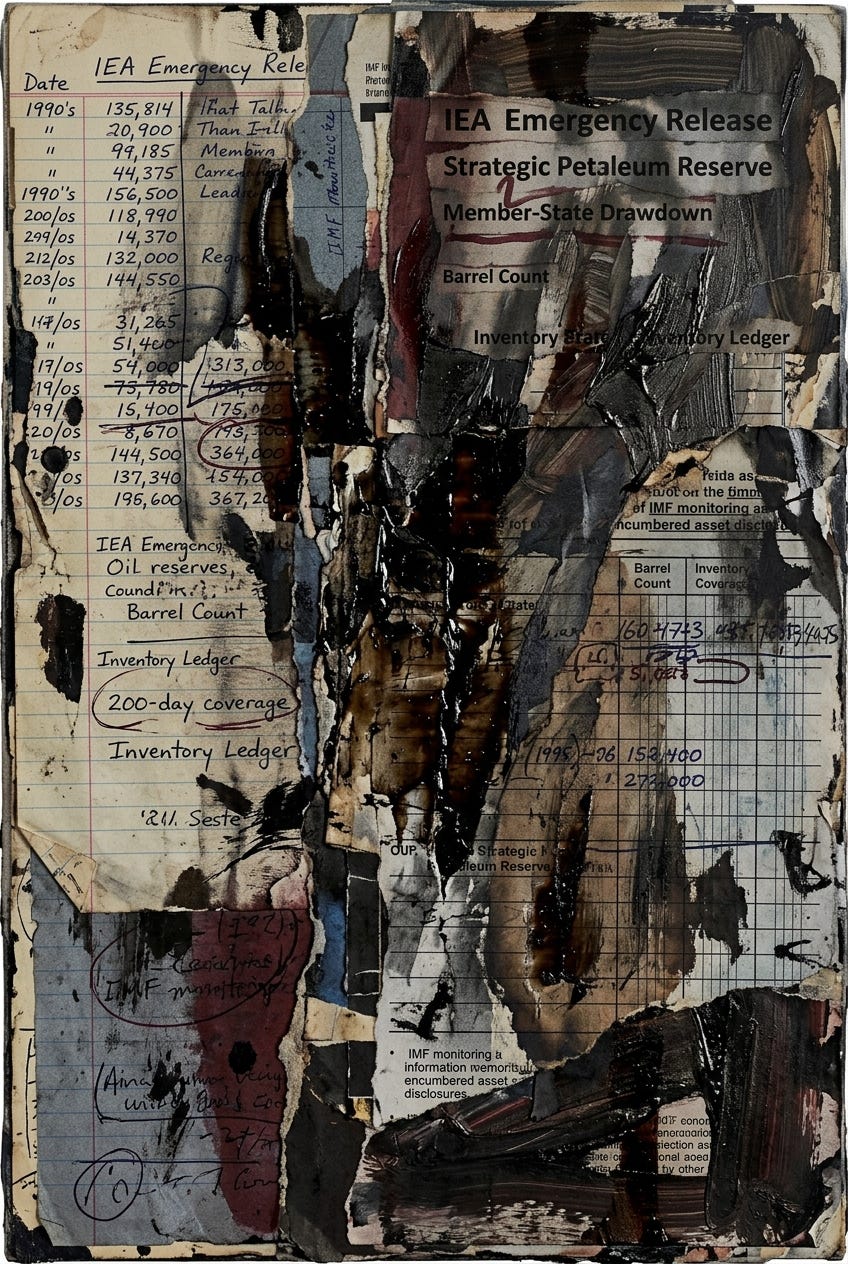
JPMorgan's thought of the week provides the structural challenge to the relief thesis, expressed in arithmetic rather than narrative. The IEA's emergency stock release in response to the Hormuz closure is the largest on record: 32 member countries releasing 400 million barrels, more than twice the amount deployed during the 2022 Russia-Ukraine conflict. JPMorgan's own quantification is explicit. The world consumes approximately 100 million barrels of oil per day. Roughly 20% of global flows, approximately 20 million barrels per day, pass through the Strait of Hormuz. The 400-million-barrel release is equivalent to 4 days of global consumption or 20 days of Strait flows. JPMorgan states directly that strategic reserves "are not designed to eliminate energy shocks, but to provide temporary flexibility during periods of disruption." The record release bought 20 days of temporary flexibility against a closure that has lasted months. The strategic stock was deployed to manage the flow. The flow price fell. The stock position does not automatically replenish.
The same JPMorgan report provides the reserve coverage map that is the week's most structurally important forensic input. Japan and South Korea each hold more than 200 days of strategic petroleum reserves. China holds approximately 120 days, comparable to Europe and Taiwan. The US holds the second-largest reserve base globally but is a net oil exporter. These are also the MSCI EM index leaders. Korea's KOSPI gained 13% in a single week. Taiwan's MSCI ACWI weight has surpassed France, China, and Canada this year to reach fourth-largest globally, per Merrill Lynch. The reserve coverage arithmetic and the equity market outperformance align precisely. Countries with 200-plus days of reserves absorbed the Hormuz shock without existential balance-of-payments stress. They are the same countries posting 13% weekly returns on memory chip demand. The countries without that buffer absorbed the same shock against reserve positions that have now been deployed.
The IMF Ghana December 2025 Article IV monitoring framework provides the precise structural contrast on the frontier end of the sovereign credit spectrum. The Bank of Ghana is required to provide weekly FX auction results, the stock of BoG FX swaps and loans, and granular encumbered asset data within one week of each week-end. This monitoring cadence is not routine disclosure. It is the IMF's operational response to a sovereign where the available reserve buffer is the binding constraint on program stability. A decline in WTI from $112 per barrel to $95.42 reduces Ghana's forward import cost. It does not restore the reserves already deployed during the months at elevated prices. As the IMF monitoring framework makes explicit, the stock of encumbered assets is tracked weekly precisely because it is the variable that does not automatically reset when oil prices reverse. The backward draw is permanent. The forward flow is the only variable that changed when the Pakistani diplomatic source cited progress toward a peace deal.
The Semiconductor Agenda at the Summit Table
The US-China summit's significance for frontier sovereign credit is best understood through the structural contradiction embedded in the summit agenda itself. Merrill Lynch's constructive framing correctly identifies the positive optics: $582 billion in bilateral trade, deep capital market entanglement, and face-to-face diplomacy at the highest level. But the same summit addresses semiconductor restrictions on the hardware driving Taiwan to the fourth-largest MSCI ACWI country weight, surpassing France, China, and Canada this year. Merrill Lynch documents the Philadelphia Semiconductor Index at 60% above its 200-day moving average, with semiconductors now representing 17% of S&P 500 market capitalization, up from 5% at ChatGPT's launch. A summit outcome that tightens semiconductor access would directly compress the AI hardware earnings premium currently anchoring MSCI EM's 22.5% year-to-date return. The reconciliation premium and the technology restriction agenda cannot both be priced at full value simultaneously in the same assets.
For the frontier sovereign credit universe, the compositional divergence documented in last Wednesday's Wrong Proxy has now widened further. MSCI EM returned 6.9% last week. The JPM EMBI Global Diversified, the hard currency sovereign credit instrument that frontier sovereigns issue, returned 0.53% over the same period per JPMorgan's fixed income data. The equity index is Korea's KOSPI and Taiwan's semiconductors. The credit index is Ghana's FX auction results and Sri Lanka's reserve position. These are not the same product. The 6.9% MSCI EM return does not describe a recovery in the frontier sovereign credit universe this desk trades. It describes an extraordinary week in the AI hardware cohort, which has delivered a return 13 times larger than the EMBI, producing a credit spread priced against a fundamentally different universe than the one generating the headline number.
India remains the largest single-credit illustration of the reserve arithmetic across four consecutive dispatches. As tracked from the April 12th Compound Ledger through last Sunday's Convergence Mirage, the IMF India Article IV was built on an energy price path that the Hormuz closure invalidated. WTI peaked at $112 per barrel and has declined to $95.42. For a sovereign whose fiscal arithmetic embeds pre-war energy assumptions in subsidy frameworks and current account projections, the decline is constructive. The backward stock of reserve pressure accumulated during the elevated-price months does not reverse. The Convergence Mirage documented investors selling rupee assets against an RBI policy stance that faces structural stress from the energy transmission channel. The $95 WTI price reduces the forward cost of the import bill. It does not validate an Article IV that never modeled $112, nor does it restore the reserve and fiscal capacity consumed during the months it took to arrive at $95.
Calibrating Against Days of Cover
We maintain Asymmetry in Latin American commodity exporters within hard currency EM debt. BlackRock explicitly maintains its overweight on hard-currency EM, citing "economic resilience, disciplined fiscal and monetary policy, and a high ratio of commodity exporters." Energy-exporting sovereigns in the Latin American basin benefit structurally from oil prices well above their fiscal breakeven assumptions even at $95 per barrel. The IEA buffer's eventual exhaustion is a Latin American commodity exporter's structural support, not a threat.
We are Cautious on frontier Asian sovereign credit where strategic reserve cover is below 90 days of import equivalent. JPMorgan's reserve coverage map is the week's most structurally precise tool for differentiating within EM fixed income. Japan and South Korea, at 200-plus days, are equity markets, not frontier credit. Sri Lanka, Pakistan, Bangladesh, and the Maldives operate with reserve buffers the IMF Article IVs consistently flag as the primary program stability constraint. The WTI decline from $112 to $95 improves the forward import cost. It does not restore the backward reserve drawdowns already executed.
We are Cautious on EM carry structures funded in yen. As documented from the Load-Bearing Defection through last Wednesday's Wrong Proxy, the BOJ carry-funding regime is tightening sequentially. Goldman Sachs this week reports BOJ intervention suspicion after the yen spiked 2% on Wednesday, with USD/JPY settling at 156.68 from a recent high near 159 to 160. The ECB June hike of 25 basis points, explicitly maintained by Goldman Sachs, represents the second simultaneous carry-funding tightening signal in the same week. Pakistan, Egypt, and Kenya duration remains priced against accommodation that both the BOJ and the ECB are actively closing.
We Prefer hard currency over local currency in EM fixed income. US CPI data, released today, was priced by consensus at 3.7% against a prior reading of 3.3%, representing the highest-frequency US rate anchor for EM local currency duration. Merrill Lynch projects full-year CPI at 3.7% and core CPI at 2.7%, with the Fed funds rate expected to remain at 3.63% through year-end 2026. With approximately three European rate hikes priced in and the ECB's June action confirmed by Goldman Sachs, the DM rate environment is compressing EM local currency duration from both major funding currencies simultaneously.
We are Cautious on the AI hardware premium within EM equities at current concentration levels. Goldman Sachs confirms the Mag 7's 61% EPS growth dwarfs the 16% growth for the other 493 S&P 500 constituents, and Merrill Lynch documents five companies driving half of the S&P 500's 17% recovery since March 30. The concentration risk Merrill Lynch identifies, the narrowness of the AI trade's earnings base, is also the specific hardware category most directly addressed by the US-China summit's semiconductor restriction agenda. The assets driving MSCI EM's 22.5% year-to-date return are the assets most directly in the summit's regulatory scope.

The Arithmetic of Sunk Costs
The distinction between flow and stock is the most important analytical frame for this week's relief trade. Oil prices are a flow variable: they update continuously, respond to supply signals and diplomatic progress, and reset the cost of the next barrel. Reserve positions are a stock variable: they accumulate during periods of external surplus and erode during periods of balance-of-payments stress. The IEA's 400-million-barrel release was a drawdown of the collective strategic stock, equivalent to 20 days of Strait flows, deployed to manage the price of the flow. When WTI declines to $95 because a Pakistani source signals progress toward a peace deal, the flow price adjusts. The stock of reserves deployed to manage the months of elevated flow prices does not return. The frontier sovereign balance sheets that absorbed the Hormuz shock at $112 per barrel are structurally different from the balance sheets that existed before the closure. The relief is real. The reset is not.
Howard Marks teaches that the most dangerous position is not the one that is priced wrong, but the one that is priced against the wrong question. The Street is asking whether the Hormuz reopening is imminent. That is the correct question for an energy trader. For a sovereign credit analyst, the question is whether the balance sheet that absorbed the months of elevated energy prices has returned to its pre-closure position. The answer, for the frontier sovereign universe this desk tracks, is unambiguously no. The IMF Ghana monitoring framework's weekly FX data requirement does not exist because the flow of oil prices is uncertain. It exists because the stock of reserve adequacy is the sovereign credit variable that matters most, and it does not reset when the flow price reverses. WTI at $95 per barrel is a more manageable environment for a frontier sovereign's external accounts than WTI at $112. It is not a return to the Article IV baseline. The bill has already been rendered. The relief trade is pricing the invoice as cancelled. It was not.
Regards,
Sovereign Dispatcher