

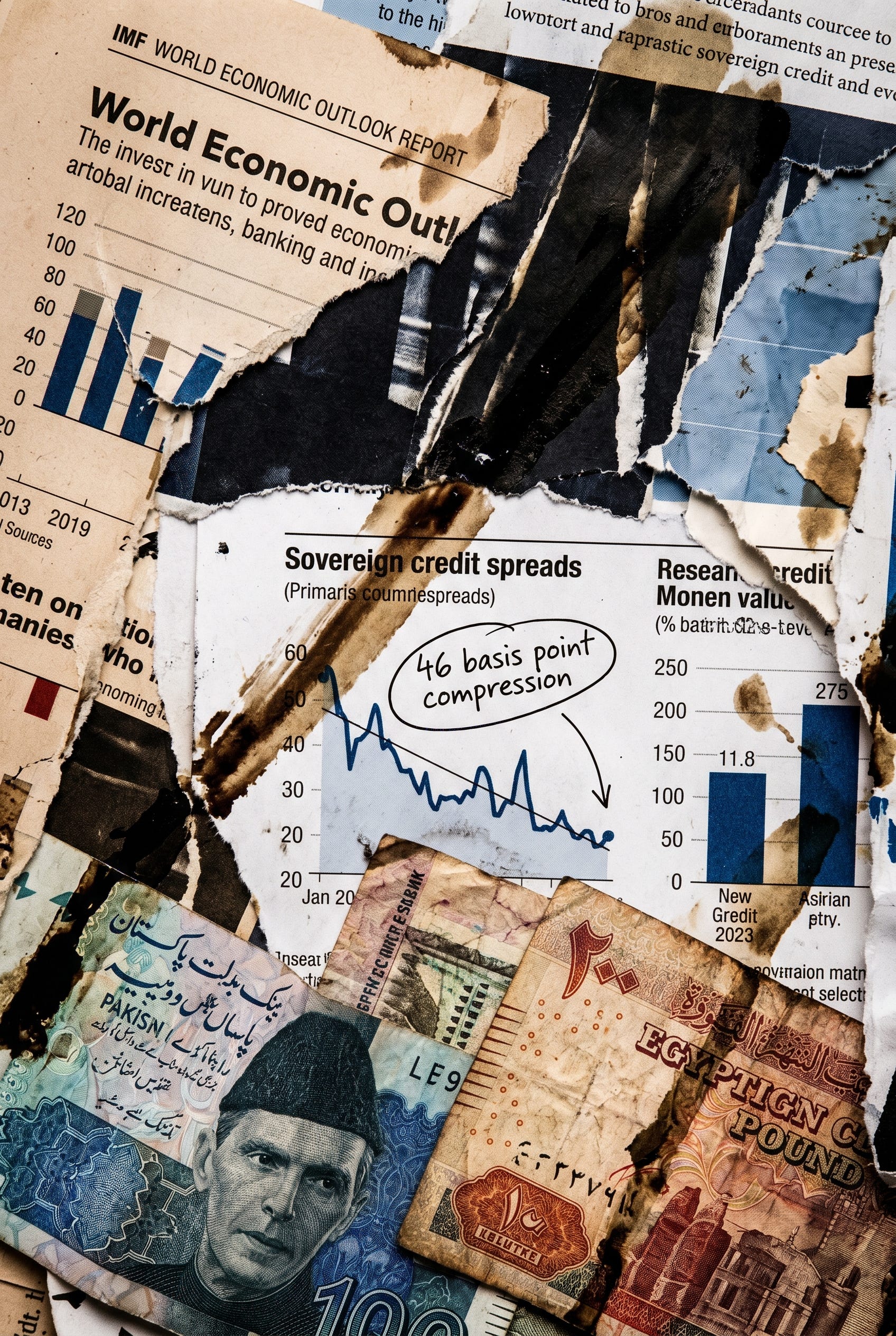
The Interval Economy. The 10-day Lebanon ceasefire, with Iran declaring the Strait of Hormuz "completely open" during this window, has compressed EMD spreads from 289 to 243 basis points in April alone. This is a 46-basis-point move priced as if the blockade is lifted and a peace deal is signed. Neither is true: Trump's US blockade remains "in full force" until a formal agreement is concluded, and the ceasefire window itself expires within the current calendar week.
The Index Proxy Trap. MSCI EM's 14.44% month-to-date gain and BlackRock's overweight upgrade are structurally accurate for Korean AI hardware exporters and Brazilian commodity producers. They are structurally irrelevant for energy-importing frontier sovereigns, where the balance-of-payments damage from six weeks of elevated oil prices compounds in fiscal arithmetic, not index performance, and where the IMF Spring Meetings this week issued a formal warning about lending adequacy.
The China Export Signal. China's March export growth of 2.5% year-over-year against a consensus of 8.3% is the week's most underpriced datapoint for Asian frontier markets. Combined with urban unemployment at a 13-month high of 5.4%, the signal is that Chinese demand, which the sell-side assumes will absorb the rebound, is itself softening on two fronts simultaneously.
The BOJ Delay as Carry Risk Accumulation. The Bank of Japan's decision to delay its April rate hike, citing the conflict's disinflationary effects, has preserved yen carry at USD/JPY 158.64. The historical record shows yen carry unwinds are the fastest transmission channel for EM contagion. The structural risk accumulates silently while the ceasefire narrative dominates the screen.

The Synchronized All-Clear: How Four Banks Converged on Identical Conviction
The weight of sell-side capital this week is positioned behind a single, unanimous thesis: the ceasefire is the inflection, and the recovery trade is now open. BlackRock's April 20th weekly commentary leads with "a supercharged AI mega force," notes that both the S&P 500 and the Nasdaq hit record highs, and upgrades hard-currency EM debt to overweight, specifically citing Latin American commodity exporters that "stand to benefit as Mideast supply plummets." Merrill Lynch's April 20th Capital Market Outlook frames the Iran conflict through a deliberate historical lens, with Joseph Quinlan's 100-year Dow Jones chart arguing that every crisis from two World Wars to COVID-19 has been succeeded by recovery. Goldman Sachs's April 17th Market Monitor confirms the consensus with data: EM equities have seen the largest earnings per share upgrades in its tracked universe at approximately 25% year-to-date. JPMorgan notes that 2026 is the first year in fifteen where analysts revised EPS estimates upward between January and April, at plus 4%, with AI technology companies driving 84% of the revision. The Street has not merely rotated into risk, it has declared the war's economic chapter closed.
The specific EM positioning this week reveals a clear trade architecture: overweight EM on commodity exporters and AI hardware manufacturers, with the energy-importing frontier universe left conspicuously unaddressed. BlackRock's granular views table is explicit: "We favor Asian countries that manufacture critical AI components and Latin American energy and commodity exporters." Goldman Sachs's fixed income strategy group is long EM currencies funded by select developed markets, a carry trade that works precisely because the strongest EM currencies this month belong to commodity exporters benefiting from elevated energy prices. BofA's Small Talks Symposium in Washington, attended by 350 clients and 20 central banks, reported broad optimism about EM inflows resuming, with Brazil receiving specific positive mention for energy exposure. The consistency is striking: every major house has constructed a self-reinforcing narrative anchored in the exporters, while the IMF's Spring Meeting, held simultaneously in Washington this week, issued a public warning that spreads have entirely failed to price.
The Interval Arithmetic: What the April Balance Sheets Actually Say
The most consequential signal of the week was not the ceasefire announcement but the International Monetary Fund's Spring Meeting conclusion, reported in our Sunday dispatch, that some developing countries may require additional lending as a consequence of the Iran conflict. This was not a forecast or a theoretical risk scenario. It was a public admission from the institution that sets the baseline for frontier sovereign credit: the existing programme envelopes for the most vulnerable borrowers are undersized for the shock they absorbed. EMD spreads, which compressed from 289 to 243 basis points across April, have not moved in response to this admission. The disconnect is the alpha.
The structural damage to frontier sovereign balance sheets from six weeks of elevated oil prices does not reverse on the day a ceasefire is announced, a point our April 13th dispatch documented in detail across India, Turkey, and Pakistan. The Reserve Bank of India's decision to defend the rupee through reserve sales rather than exchange rate adjustment made the deterioration invisible in price data and visible in import cover. Turkey's extraordinary $20 billion intervention in March reversed the reserve accumulation that the IMF's 2025 Turkey Article IV identified as the central programme success metric. Pakistan's $3.5 billion repayment to the UAE, which we flagged as a structural crack in the bilateral financing architecture of the IMF Extended Fund Facility, remains unreversed by any equivalent bilateral commitment. These are not market prices. They are balance sheet facts, and balance sheets do not reprice on a 10-day ceasefire extension.
The IMF's World Economic Outlook framework on emerging market resilience identified three pillars that determine which sovereigns can absorb external shocks: current account positioning, reserve adequacy, and debt service capacity. By all three measures, the energy-importing frontier universe, Pakistan, Egypt, Kenya, Ghana, Sri Lanka, entered the Iran conflict in a structurally weaker position than the Asian crisis survivors the sell-side is using as analogues. Merrill Lynch's reference model is South Korea and Taiwan in 2022, which held 80% of regional market capitalization in outright current account surplus, per their April 20th analysis. The frontier sovereign reference model is Egypt, which entered 2026 with an external financing gap, a GCC-dependent current account, and a population absorbing a food inflation shock driven by the same Hormuz disruption that elevated urea and ammonia prices across North African agricultural input costs.
The Bandwidth Between the Headline and the Sovereign: Where the EM Rally Does and Does Not Reach
The MSCI EM's 14.44% month-to-date gain and the JPM GBI-EM's 5.21% local currency return are real numbers that describe a real phenomenon, but they describe it for a specific subset of the EM universe that does not map onto the energy-importing frontier sovereign credit market. As we documented in last Wednesday's dispatch, the MSCI EM's return composition is overwhelmingly generated by Korean and Taiwanese AI hardware manufacturers and Latin American energy exporters. Taiwan's equity market capitalization reached $4.13 trillion on April 17th, surpassing the UK to become the world's seventh-largest market, driven by the AI hardware export cycle that is irrelevant to the credit risk of a Kenyan eurobond or a Pakistani dollar sukuk. The relief rally in hard-currency EM debt, which tightened EMD spreads from 289 to 243 basis points, is similarly concentrated: BlackRock's overweight in hard-currency EM debt is explicitly directed at "Latin American commodity exporters such as Brazil that stand to benefit as Mideast supply plummets."
The carry trade infrastructure that Goldman Sachs has built long EM currencies funded by a weak yen at USD/JPY 158.64 represents a structural vulnerability that the current ceasefire narrative has converted into a structural tailwind, but only temporarily. The BOJ's delay is a gift with an expiry date. When the conflict resolves, the normalisation path resumes, the yen strengthens, and the carry unwind hits EM local currency positions with the speed that characterises historically compressed carry unwind events. The complication is that the size of the current yen carry position correlates directly with the magnitude of the eventual unwind. The current position, built during a month when the BOJ cited conflict-driven disinflation as cover for delay, is large by any historical comparison.
China's March export deceleration to 2.5% year-over-year against an 8.3% consensus is the week's most underpriced signal for frontier EM manufacturers in Asia. The deceleration is not a conflict aftershock. It is a pre-conflict trend masked by the February 2026 export surge of 39.6%, driven by front-loading ahead of anticipated tariff changes. The structural read is that Chinese domestic demand, with urban unemployment at a 13-month high of 5.4% and an economy still reliant on government transfer spending rather than private consumption, is not the demand engine that will absorb the manufacturing export pipelines of Vietnam, Bangladesh, Cambodia, and the Philippines. Asian frontier manufacturing exporters are caught in a deteriorating demand environment precisely as their energy import costs remain above pre-conflict levels.
The Financing Arc: Positioning Within the Temporal Misread
We are Cautious on frontier sovereign credit instruments that have compressed within the broader EMD spread tightening from 289 to 243 basis points. The compression reflects exporter performance and ceasefire relief, not a structural improvement in the balance-of-payments trajectories of the energy-importing frontier universe. Egypt, Pakistan, Kenya, and Ghana represent the specific jurisdictions where the compression is most disconnected from the IMF Spring Meeting's lending adequacy warning.
We maintain Overweight on Latin American hard-currency sovereign credit, consistent with BlackRock's explicit positioning and the structural commodity exporter thesis. Brazil and Colombia benefit from the same oil price elevation that compresses frontier importer margins. This is a genuine structural trade, not a composition error, and the EMBI's LatAm concentration means the index itself provides partial expression of this view.
We are Cautious on EM local currency carry positions funded by yen at USD/JPY 158.64. The BOJ's delay is a gift with an expiry date. When the conflict resolves, the normalisation path resumes, and the yen carry unwind is historically the fastest transmission channel for EM contagion. Position sizing should reflect this temporal asymmetry, particularly in the context of FOMC and ECB meetings scheduled for April 29th and 30th, which could reset the rate differential framework.
We maintain Asymmetry in the frontier sovereign credit space by distinguishing between IMF programme countries with locked-in financing architectures (Zambia post-restructuring, Kenya under its current facility) and those with bilateral financing stacks under visible pressure (Pakistan, where the $3.5 billion UAE repayment documented in our April 13th dispatch has not been replaced by equivalent bilateral commitment from any partner).
We are Selective in Asian local currency sovereign debt, specifically avoiding the assumption that MSCI EM's regional return translates into improved sovereign credit metrics for frontier Asian issuers. The China export miss at 2.5% versus 8.3% consensus is a leading indicator of demand deterioration for Vietnam, Bangladesh, and the Philippines, precisely where the sell-side has assumed manufacturing export resilience provides a natural credit buffer.
The Confidence of the Incomplete Data Set
The sell-side's unified confidence this week rests on a structural assumption that the analyst tools available to equity strategists, index returns, EPS revisions, and PMI aggregates, are sufficient to assess the credit health of the sovereign universe. They are not. Index returns aggregate exporter performance and importer damage into a single number. EPS revisions describe AI hardware companies in Taipei and energy producers in Bogota. PMI aggregates, which the Street is watching next week as the principal growth signal, measure manufacturing output and order books, not the reserve depletion rate of central banks defending exchange rates through intervention rather than adjustment. The IMF's Spring Meeting warning about developing country lending adequacy was not a PMI print or an EPS revision. It was an admission from the institution that reads the balance sheets the equity strategist does not model.
The second-level investor's edge this week is not in knowing that the ceasefire is incomplete, the market prices that. The edge is in knowing that the 46-basis-point EMD spread compression treats the ceasefire as the endpoint rather than the interval. The gap between the market's interval-as-endpoint pricing and the IMF's balance-sheet-damage-is-real assessment is where the structural alpha resides. Marks has argued that the most dangerous words in investing are "this time is different." This week's equivalent is "this ceasefire is enough." For the Latin American commodity exporter, it may be. For the energy-importing frontier sovereign managing a bilateral creditor stack that was already under pressure before the first tanker was diverted, it is categorically not.
Regards,
Sovereign Dispatcher