

KEY TAKEAWAYS
The Energy Straitjacket: While the market fixates on the political theater of the Iran conflict, the structural reality is an immediate energy tax on Asia’s highly open, commodity-importing economies.
The Semiconductor Mirage: The consensus narrative of an AI-driven export recovery in Asia is colliding with active torpedo warfare and rising logistics costs, threatening current account assumptions for tech exporters.
The Fiscal Credibility Void: Fitch’s outlook downgrade on Indonesia exposes the fragility of fiscal promises made during the election cycle, proving that rating agencies are increasingly intolerant of policy drift.
The Alpha: We are moving to a Cautious stance on North Asian sovereign credit and highly exposed NBFIs, while remaining Constructive on defensive, domestically-anchored structures that avoid the maritime crossfire.

THE ILLUSION OF ISOLATION
The market spent the weekend pretending that a geopolitical conflagration in the Gulf could remain geographically contained, ignoring the immediate transmission mechanism of global energy markets. The sudden plunge in South Korean equities—a violent 12% single-day correction—serves as a brutal awakening for investors who assumed Asia would simply sleepwalk through the Middle Eastern crossfire. The price action implies a frantic repricing of a “Best Case” scenario where the semiconductor cycle was supposed to insulate tech exporters from external shocks. However, this optimism completely misunderstands the second-level reality: you cannot model a soft landing for a highly open, energy-dependent manufacturing hub when the fundamental cost of its primary input is skyrocketing. The behavioral anchor holding up Asian valuations has snapped, forcing a transition from blind beta-chasing to acute vulnerability assessment.
THE ANATOMY OF AN IMPORT SHOCK
To understand the severity of this external shock, we must cross-reference the market’s panic with the IMF’s baseline math for highly open economies like South Korea. The Fund explicitly warns that Korea’s close trade linkages make it uniquely susceptible to geoeconomic fragmentation and conflict-related trade disruptions, predicting that such events would severely damage business confidence and increase financial market volatility. When you combine active torpedo warfare near Sri Lanka with a surge in European gas prices, you create a massive, negative terms-of-trade shock for a commodity importer. This isn’t just a sentiment problem; it is a mathematical erosion of the current account surplus that underpins sovereign credit stability.
Furthermore, the domestic plumbing in these exposed markets is not equipped to handle a synchronized growth and inflation shock. The IMF has highlighted rising liquidity and insolvency concerns within weak Non-Bank Financial Institutions (NBFIs), specifically noting that mutual savings banks suffer from higher Non-Performing Loans and lower provisions. If a slowdown in AI-related spending reduces demand for memory chips exactly as energy input costs spike, the resulting squeeze on manufacturing profitability will rapidly migrate into the financial sector. The Treasury Put may suppress long-end volatility in the US, but it offers precisely zero protection to an Asian NBFI facing a localized liquidity crisis.

THE POLICY VACUUM AND CREDIBILITY DRAIN
As the energy shock cascades through global supply chains, the tolerance for fiscal experimentation in Emerging Markets has evaporated overnight. Fitch’s decision to lower the outlook on Indonesia due to an “erosion of credibility” surrounding President Prabowo’s economic policies is the canary in the coal mine. When the global liquidity tide recedes—or in this case, when external input costs violently rise—sovereigns with structural deficits lose the benefit of the doubt. The market is suddenly forcing a repricing of risk premiums on local currency bonds where political promises clash with mathematical reality.
This dynamic shifts the Alpha from identifying growth proxies to surviving the fundamental squeeze on vulnerable balance sheets. As we noted previously regarding the funding squeeze in Sub-Saharan Africa, the penalty for fiscal slippage is asymmetrical. If a country like Pakistan allows geopolitical entanglement—such as signaling closer defense pacts with Saudi Arabia in the midst of an Iran war—to threaten its nascent macro stability programs, bilateral bailout flexibility will vanish. The frontier translation of this week’s chaos is simple: avoid any sovereign where idiosyncratic political risk overrides the fundamental macro thesis, because the safety net has been removed.
THE FRAGILITY LEDGER
We are Cautious on South Korean local currency assets and NBFI-adjacent debt, as the terms-of-trade shock mathematically breaks the soft-landing consensus.
We are Cautious on Indonesian IndoGBs until the fiscal architecture provides concrete evidence of discipline to reverse the rating agency skepticism.
We Prefer underweight positioning in Pakistan sovereign credit, viewing the geopolitical entanglement as a toxic overlay on an already precarious IMF program.
We are Constructive on domestic demand-driven sovereigns that possess organic buffers against the structural maritime tariff currently inflating global energy flows.
THE TOLLBOOTH AT THE END OF THE CYCLE
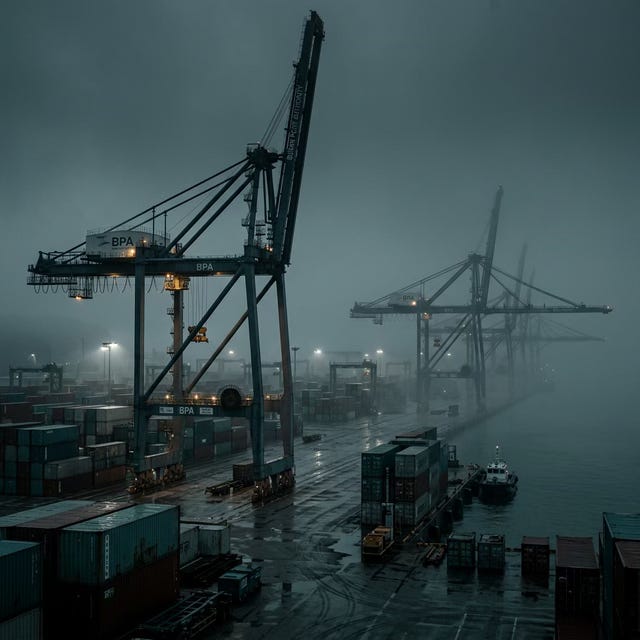
The most dangerous assumption in sovereign credit is the belief that globalization guarantees the safe passage of goods and capital regardless of who controls the waters.The market is slowly realizing that a torpedo near Colombo or a rerouted tanker in the Gulf is not an isolated news event, but an invisible, un-hedged tax on every highly open economy in our investment universe. When the cost of moving atoms suddenly spikes, the models that predicted a smooth moderation in regional inflation become instantly obsolete. We are moving from an era where liquidity masked all fundamental sins to a regime where geopolitical proximity is priced directly into the sovereign yield curve. The tollbooth is raising its prices, and the market is vastly underestimating who will be forced to pay. Position accordingly.
Regards,
Sovereign Dispatcher