

KEY TAKEAWAYS
Turkey Has Entered a Compound Sovereign Credit Deterioration, With Monetary and Political Anchors Breaking in Consecutive Weeks. Last week the central bank abandoned the 16% inflation target and raised it to 24%; this week a court ousted Erdogan's leading political rival, triggering capital outflows and a government scramble to calm investors, compressing the two conditionality pillars the IMF programme was premised on simultaneously.
Indonesia's State Enterprise Export Monopoly Transforms the Fiscal Revenue Mechanism the IMF's Article IV Modelled as Market-Based. Jakarta's announcement of a state-owned sole exporter for palm oil, thermal coal, and nickel introduces transfer pricing risk and international trade friction that the Indonesia Article IV's fiscal projections did not model, creating a structural disconnect between commodity prices and sovereign revenue capture.
Modi Has Publicly Retired the Energy Price Shield That the IMF April 2025 Article IV Used as a Balance-of-Payments Buffer. India's prime minister explicitly told citizens he can no longer absorb the Iran war's cost shock, marking the fourth consecutive dispatch documenting India's deterioration and the first week it has received explicit government acknowledgment rather than only financial market signal.
Fuel Protests Are Spreading Across Africa at the Exact Moment the BOJ Has Received Its Third Consecutive Carry-Funding Deterioration Signal. Kenya, Mozambique, and Comoros report violent fuel price protests while Japan's solid Q1 GDP has further cemented the June rate hike trajectory, tightening the carry premium that funds African frontier duration from both the demand and supply sides simultaneously.

Pricing the Deal, Ignoring the Admission
The market's dominant frame this week is deal optimism: Secretary Rubio declared good signs for a US-Iran agreement, US-China trade talks returned to the APEC agenda, and the South Korea Kospi extended a run that has tripled in eighteen months on AI demand from Samsung and SK Hynix. The Economist devoted a leader to how America's economy is soaring even with the MAGA tax. Malaysia and Singapore exports are surging on the AI boom, defying the Mideast shock. If the consensus has a thesis, it is that the structural weight of the Iran war is beginning to lift, the diplomatic pipeline is filling, and the APEC re-engagement signals a wider thaw in the geopolitical architecture.
The sovereign credit analyst's task is to identify what was admitted this week while the market was pricing the deal, and three governments provided the answer with unusual directness. India's prime minister told his citizens publicly that he can no longer shield them from the impact of the Iran war. Indonesia announced a state enterprise to monopolize three of its flagship commodity exports. A Turkish court ousted the leading opposition figure, triggering capital flight that the government had to address before the week was out. None of these were minor policy calibrations. Each was a public admission that a prior framework, the managed energy price buffer, the market-based commodity export mechanism, the politically stable monetary reform programme, is no longer operative. The market priced Rubio's optimism. It has not priced the admissions.
The Framework Retirement
Turkey's sovereign credit situation this week has no precedent in the current Iran war cycle because it is the only credit on the watchlist that has broken two programme conditionality anchors in consecutive weeks, and the market has not repriced either break. Last week, the central bank formally abandoned the 16% inflation target and raised it to 24%, breaking the monetary credibility anchor the IMF's Turkey programme conditionality was premised upon. This week, a court's ousting of the leading political opposition figure triggered immediate capital outflows and a government statement seeking to calm investors, placing the political legitimacy anchor under equivalent pressure. The IMF's Turkey programme requires both anchors to function: monetary credibility to anchor the disinflation path, and political legitimacy to sustain the reform mandate and maintain investor confidence in the external financing programme. Both are now simultaneously unreliable. Turkey's maturity wall in external debt has not moved. The carry trades attracted by the rate differential were priced against a central bank with a credible target and a government with stable political backing. Neither condition currently holds.
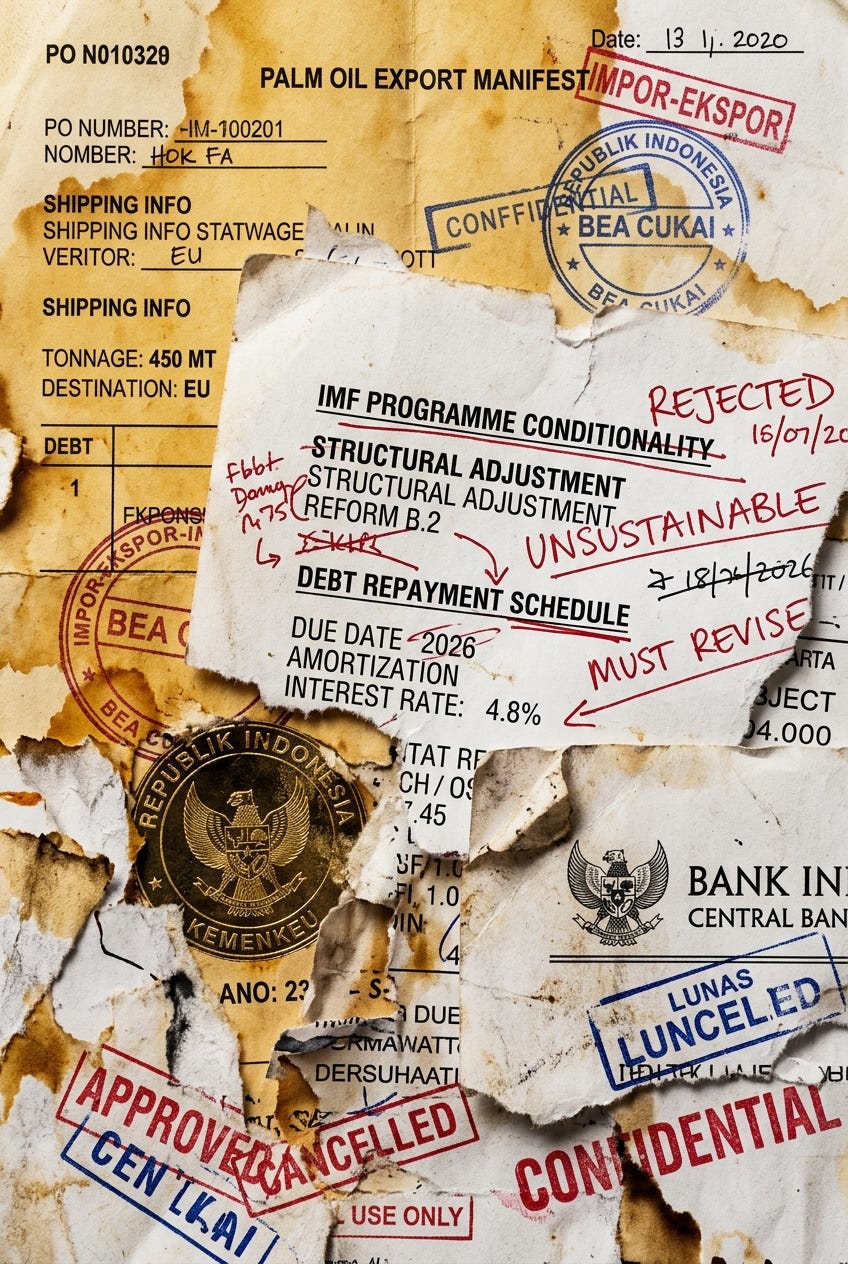
Indonesia's export nationalization is a structural fiscal mechanism change the sovereign credit market is treating as an industrial policy announcement, which is the precise misreading the Milo framework exists to identify. The IMF's Indonesia Article IV modelled commodity export revenues as competitively market-priced through private-sector export channels. A state enterprise monopoly over palm oil, thermal coal, and nickel introduces three distinct revenue distortions: transfer pricing risk, where the state can sell below market to preferred bilateral partners without the fiscal capture obligation that private exporters carry; international trade friction, where palm oil's EU market access is premised on private-sector sustainability certification chains that a state monopoly complicates; and operational efficiency loss, where private exporters systematically outperform state enterprises on cost and timing. FT Alphaville characterized Indonesia this week as being at a perpendicular intersection of two different roads and raised the question of whether it operates the worst ageing fuel subsidy in the world. The bondholder's question is not which road Jakarta takes but how much fiscal revenue variance the state enterprise transition introduces into Indonesia's sovereign trajectory.
The Shield's Removal and the Queue at the Pump
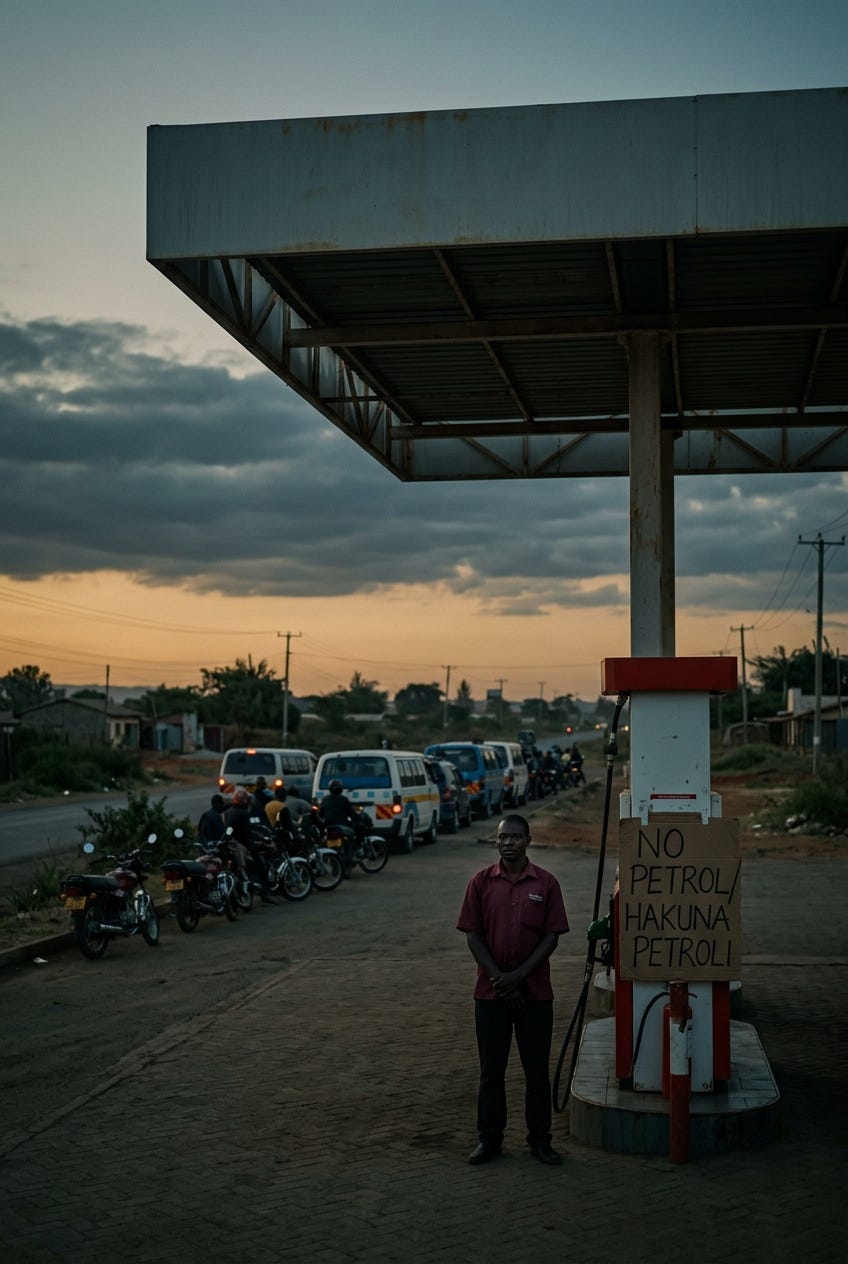
The connection between Modi's announcement and the fuel queues spreading across African frontier markets is not geographical but structural: both are the downstream consequence of the Iran war energy supply disruption arriving at the balance-of-payments boundary that the IMF's pre-war Article IVs modelled as a managed, buffered interface. India's managed domestic fuel price regime was one of the last operating cushions between the international oil price and the domestic purchasing power of the world's most populous nation. Modi's public retirement of that cushion signals that import costs are now passing through fully and unmediated to domestic prices. In Africa, the cushion equivalent was the sovereign fuel subsidy that Kenya, Mozambique, and Comoros maintained against international diesel and petrol prices. The protests spreading across all three are the political consequence of those subsidies being exhausted or withdrawn. The IMF's fiscal programmes for Kenya and Mozambique had flagged subsidy reform as a conditionality requirement; the Iran war has forced that reform at a pace the Fund's programme sequencing did not anticipate.
The BOJ dimension compounds the Africa-Asia energy importer deterioration in a manner the consensus has still not integrated into a unified analytical frame, despite this being the third consecutive week the signal has been confirmed. Japan's Q1 GDP printed solid this week, described by FT as supportive of a June rate rise, making it the third consecutive data confirmation of the hawkish normalisation trajectory flagged in the Load-Bearing Defection dispatch (May 3), confirmed in the Convergence Mirage (May 10), and elevated in the Communiqué and the Conflagration (May 17). The carry structures funding Pakistan, Egypt, Kenya, and Ethiopia sovereign duration were priced against BOJ accommodation. That accommodation is closing in a straight line. The fuel protests in Kenya are a domestic political shock. The BOJ normalisation is an external carry shock. Both are arriving simultaneously at the balance sheet of a credit where the IMF programme fiscal assumptions were calibrated to neither.
The Policy Framework Register
We are Cautious on Turkish external debt across the capital structure. The compound break of two consecutive conditionality anchors, monetary credibility in the week of May 17 and political legitimacy in the week of May 24, has not been repriced into Turkish duration or external financing expectations. The maturity wall has not changed. Reserve pressure from capital outflows compounds the reserve adequacy trajectory already deteriorating under the inflation target abandonment. Until the IMF revises its Turkey programme conditionality assessment to reflect both breaks, the spread remains materially mispriced.
We are Cautious on Indonesia commodity-linked sovereign credit over a 12-month horizon. The state enterprise export monopoly announcement introduces fiscal revenue variance that the current spread does not price. Transfer pricing risk, EU trade friction for palm oil, and state enterprise operational efficiency differentials are not reflected in the Indonesia sovereign spread. Monitor the first state enterprise export contract for evidence of below-market pricing to bilateral partners as the critical early indicator of fiscal capture deterioration.
We are Cautious on India across the capital structure, as tracked across four consecutive dispatches since the April 26th Compound Ledger. Modi's explicit public retirement of the energy price shield is not a marginal data point; it is the political acknowledgment that the IMF April 2025 Article IV BOP model is no longer operative. The viral youth unemployment protests confirm the deterioration is reaching the real economy's social stability dimension, not only the financial account. The spread has not moved.
We are Cautious on African frontier energy importers with active IMF programmes, specifically Kenya and Mozambique. Fuel price protests spreading to mass unrest signal that subsidy reform conditionality is arriving at a pace that creates social stability risk the IMF's programme sequencing did not model. Monitor whether the Fund invokes social stability safeguard clauses in Kenya's Extended Fund Facility.
We Observe constructively Malaysia and Singapore's AI-driven export surge as the week's measurable evidence that the Iran war bifurcation is real: technology-intensive, energy-efficient exporters are defying the Mideast shock while energy importers deteriorate. The divergence is not a narrative construct. It is in the export data.
The Price of Institutional Permanence
The most persistent market error in this Iran war cycle is not mispricing a single credit but mispricing a category of assumption: the assumption that the institutional frameworks the IMF used as its April 2026 baseline constants are structural permanencies rather than contingent equilibria. Turkey's inflation target was described as a credibility anchor, not a temporary measure. Indonesia's commodity export market was described as functioning on competitive terms, not on the verge of nationalization. India's energy price management was described as a policy buffer, not a political commitment that a prime minister would publicly withdraw under external pressure. Each of these was priced as permanent at the time the IMF drew its map. Each was retired this week. The bond priced against a permanent institution that has since been retired does not know it is mispriced. It continues to carry, yielding steady premium for the holder's confidence in a framework that the government has already left behind.
Regards,
Sovereign Dispatcher