

KEY TAKEAWAYS
The Rewiring: The market is treating “De-Dollarization” as a theory, but the data shows it is a trade; capital is flowing into “Non-Aligned” sovereigns (India) while fleeing “US-Dependent” exporters (Mexico).
The Jakarta Flush: As we warned last week, the “Governance Discount” in Indonesia has mutated into a liquidity event; foreign outflows are testing the central bank’s pain threshold.
The Takaichi Reality: Japan’s refusal to intervene in the Yen is not passivity, it is policy; the “weak Yen” export subsidy is the new normal, keeping the carry trade alive but volatile.
The Asymmetry: We are adjusting positioning to be Constructive on India (Infrastructure/Tech) while moving to Cautious on broad Indonesian Beta until the governance dust settles.

THE SILENT REWIRING
The market spent the week celebrating the “resilience” of Emerging Markets in the face of US tariff threats, mistaking a structural rewire for a cyclical bounce. While the headlines focused on the bluster from Washington, the real signal was in the silence of the plumbing. India signed a trade pact with Europe, China pushed the RMB into new commodity corridors, and the “Non-Aligned” bloc effectively hedged the US election risk by creating their own demand centers. The price action implies a ‘Best Case’ scenario where global trade continues uninterrupted; however, the flows suggest something far more profound. Investors are not buying “EM Beta” indiscriminately; they are buying the sovereigns that have successfully insulated themselves from the weaponization of the Dollar. The “Trump Hedge” isn’t gold; it’s the supply chain that bypasses the White House.
THE FRAGMENTATION PREMIUM
While the Street chases the momentum in equity indices, the IMF’s latest WEO update applies a cold compress to the unbridled enthusiasm regarding global integration. The Fund’s baseline explicitly warns that “fragmentation risk” has graduated to “fragmentation reality,” noting that the cost of cross-border capital allocation is rising for nations outside the primary “friend-shoring” blocs. The technical reality is visible in the divergence of Import Cover ratios. Sovereigns relying on the traditional petrodollar cycle are seeing reserves plateau, while those integrated into the new “Strategic Mineral” corridors (like the DRC and India) are seeing an organic accumulation of hard currency, bypassing the traditional SWIFT bottlenecks.
This bifurcation creates a “Fragmentation Premium” that is not yet priced into sovereign spreads. When we analyze the Primary Deficits of our core universe, a distinct pattern emerges: nations aligning with the new multipolar trade architecture are funding their deficits through direct bilateral investment, effectively off-loading their maturity walls to strategic partners. In contrast, those relying on hot portfolio flows are facing a steepening curve as foreign investors demand higher compensation for the “political risk” of being on the wrong side of the trade war. The solvency math hasn’t changed, but the liquidity mechanics have fundamentally decoupled.
THE ALIGNED VS. THE EXPOSED
How does this global macro “rewiring” impact the bondholder in New Delhi versus the portfolio manager in Jakarta? For India, the shift is a distinct tailwind. As we flagged in previous notes, New Delhi’s refusal to pick a side has allowed it to become the ultimate “Swing State” for capital. The EU trade deal is not just a diplomatic win; it is a structural bid for Indian assets that lowers the country’s reliance on USD funding. The bondholder in India is effectively long “Geopolitical Optionality,” getting paid to hold an asset that benefits from the US-China friction rather than suffering from it.
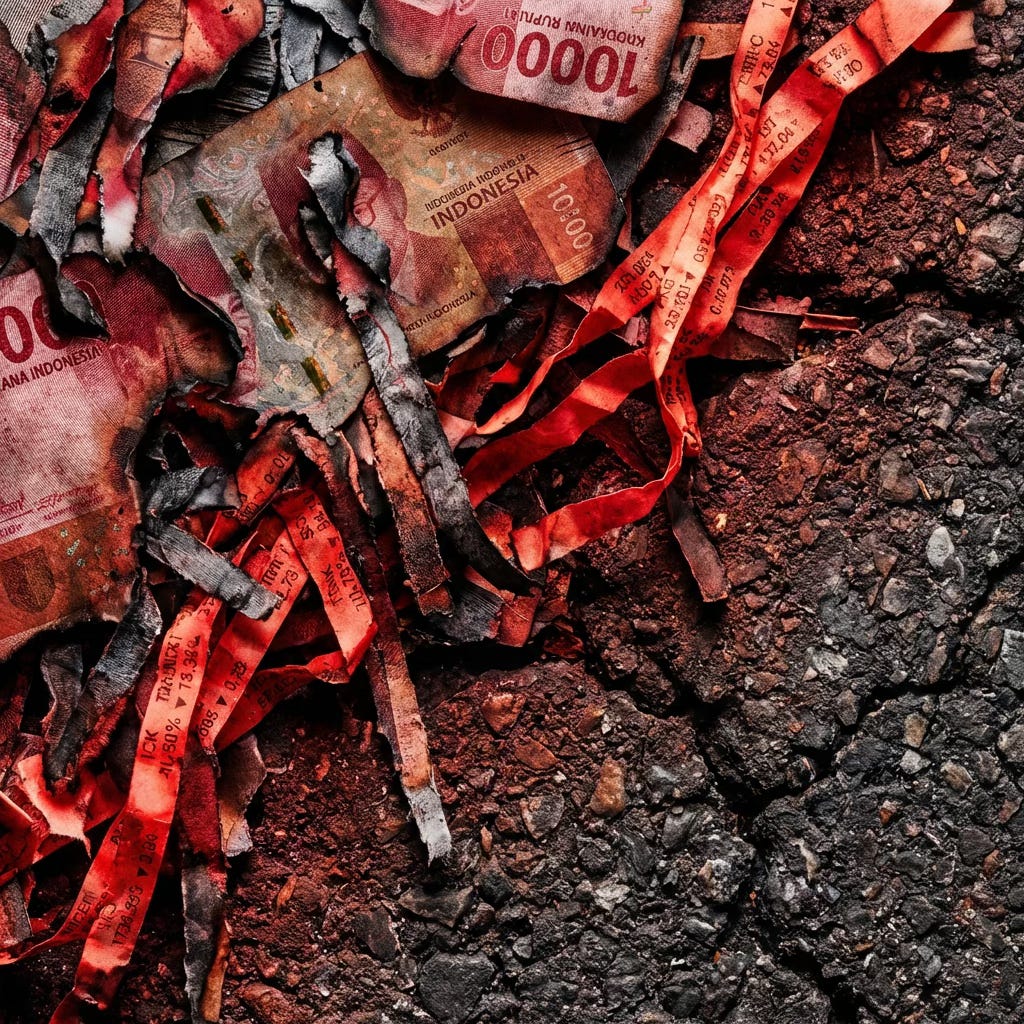
Conversely, the risk premium in Indonesia acts as a cautionary tale of what happens when “Governance” fails to align with “Opportunity.” As we warned last week regarding the “Governance Discount,” the market has zero tolerance for institutional erosion in this environment. The crash in the Jakarta Composite is not merely a reaction to external tariffs; it is a rejection of domestic policy uncertainty. The bondholder in Jakarta is no longer shielded by the commodity cycle; they are exposed to the raw volatility of capital flight. The “Frontier Translation” is clear: in 2026, you get paid for Alignment (strategic relevance), but you get punished strictly for Ambiguity.
THE WATCHLIST
INDONESIA: We remain Cautious. The “stops triggering stops” dynamic we discussed is active. The governance failure has become a liquidity event. We fade the dip until the MSCI review clarifies the capital flow outlook.
INDIA: We are Constructive. The Capex pivot and the EU deal confirm our thesis. We prefer long duration in the Infrastructure and Tech sectors, which are the direct beneficiaries of the “Trump Hedge.”
JAPAN: We see Asymmetry. As noted last week, the “Takaichi Trade” implies a weaker Yen for longer. This supports the equity carry but keeps us underweight JGBs as the curve must eventually reprice the inflation pass-through.
CONGO (DRC): We are watching the Proxy. The Cobalt deal is the test case for US execution. If the deal holds, spreads compress; if it fails, the geopolitical bid evaporates.

THE PRICE OF AUTONOMY
The market seemingly assumes that strategic autonomy is a cheap commodity, accessible to any sovereign willing to issue a press release. In reality, the ability to say “no” to a hegemon or to successfully play two against one another is the most expensive asset in the sovereign toolkit. It requires deep domestic savings, credible institutions, and a relentless focus on the balance sheet. The current rally in “Non-aligned” assets suggests the market is beginning to price this autonomy correctly, not as a political quirk, but as a fundamental credit enhancement. The “free lunch” in 2026 isn’t diversification; it’s owning the sovereigns that have paid the upfront cost for their own destiny.
Regards,
Sovereign Dispatcher